Search

SCG Fiber Cement Sheet vs Plasterboard vs MgO Board for Australian Builders

Share this post :

Facebook
LinkedIn
SCG Fiber cement sheet for Wall&Ceiling

Key takeaways

No single board fits every application

SCG Fiber Cement Sheet, plasterboard, and MgO board each serve different purposes. The best choice depends on moisture exposure, durability requirements, fire performance, and whether the application is internal or external.

Plasterboard is the most efficient option for dry interiors

It remains the preferred solution for standard internal walls and ceilings due to its smooth finish, low cost, and ease of installation. However, it is not designed for weather-exposed or high-moisture environments.

SCG Fiber Cement Sheet offers the broadest versatility

Suitable for both internal and external applications, it provides strong resistance to moisture, termites, and impacts. This makes it ideal for wet areas, eaves, soffits, garages, high-traffic spaces, and exterior-facing applications.

MgO board requires careful verification

While often marketed as fire-resistant and moisture-resistant, performance can vary significantly between manufacturers. Builders should demand local testing, compliance documentation, and evidence of long-term durability before specification.

Whole-of-life value matters more than sheet price

Material selection should consider installation costs, compliance requirements, maintenance, durability, moisture risks, and potential future repairs—not just the initial purchase price. A slightly higher-cost board can deliver lower lifecycle costs and reduced project risk

For Australian builders, the right sheet material is not simply the one with the lowest upfront rate. The better decision depends on exposure, substrate, fire pathway, wet-area detailing, impact risk, finishing expectations, and how easily the product can be sourced with the right documentation. For a broader look at SCG’s building material solutions tailored to local conditions, visit the SCG Australia page

This sheet material comparison looks at three common cement board options and lining choices: SCG Fiber cement sheet, plasterboard, and MgO board. Each can be useful, but they are not interchangeable. To set expectations, this is an SCG Fiber Cement Sheet vs Plasterboard vs MgO Board (comparison for Australian builders) designed to support clear, documented decisions.

Quick verdict for builders

Choose SCG Fiber cement sheet when the project needs a tough, versatile Fiber Cement Board for internal and external walls, partitions, ceilings, eaves, soffits, and selected flooring or substrate applications. SCG describes its Fiber Cement Board as made from Portland cement, silica, and cellulose fibre, and positions it for walling, ceiling, flooring, internal use, and external use. It also highlights high impact strength, water resistance, termite resistance, thermal insulation benefits, design flexibility, and lightweight installation.

Choose plasterboard when speed, smooth internal finishing, trade familiarity, and cost efficiency are the main priorities in dry residential or commercial interiors. Standard plasterboard is highly practical for bedrooms, living areas, offices, corridors, and ceilings, but it needs protection from weather and moisture and should not be treated as an exterior sheet cladding material.

Choose MgO board only when the supplier can provide credible, project-specific evidence for durability, fire, moisture, fixing compatibility, and Australian compliance. MgO boards are often marketed as fire-rated, impact-resistant, mould-resistant, and lightweight, but research into some magnesium oxychloride boards has shown moisture uptake, salty water leakage, corrosion, mould, and facade damage in humid conditions.

What each board is best known for

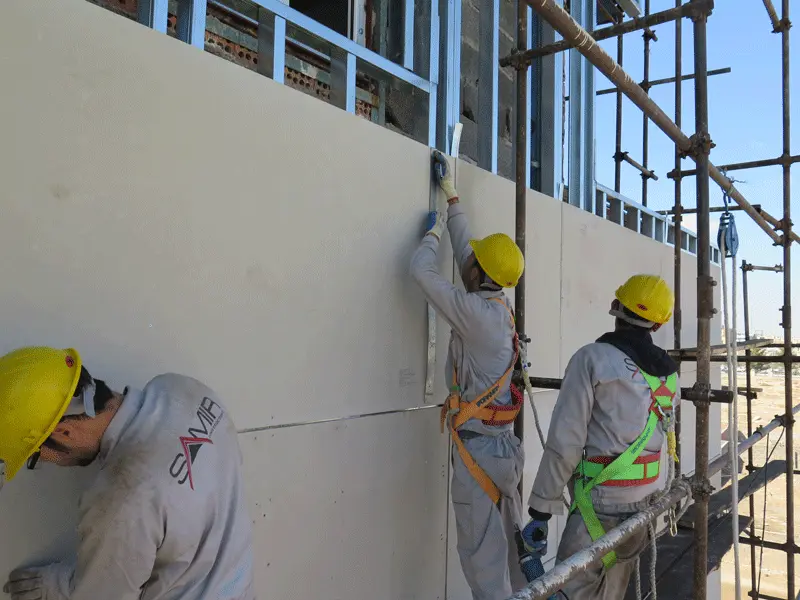
fiber cement sheet cladding on building project

SCG Fiber cement sheet

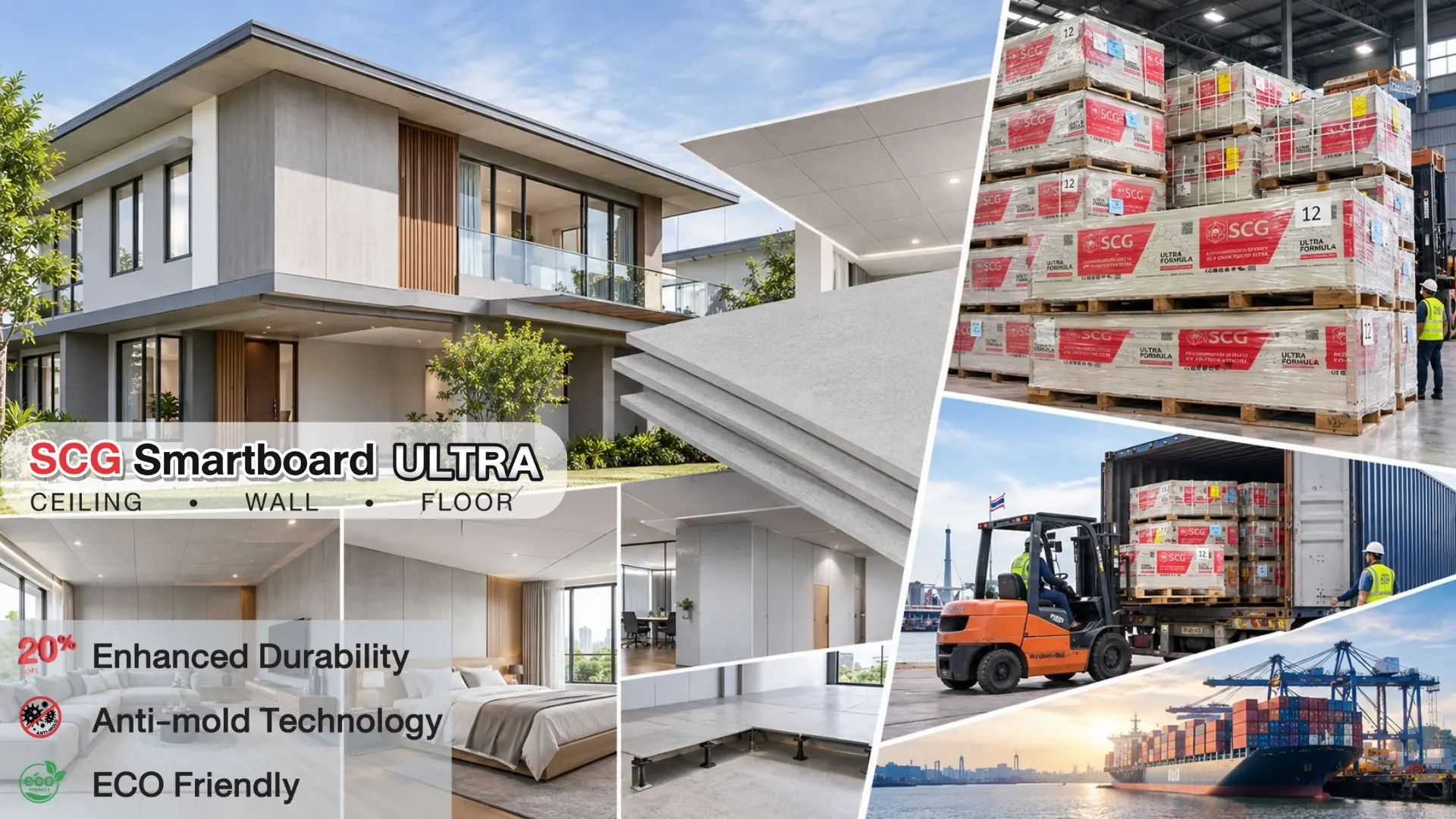
SCG Fiber cement sheet, also referred to by SCG as SCG Smartboard, is a cement-based board designed for broad use across building envelopes and interiors. In a practical Australian context, that makes it a strong candidate for builders who want one product family that can cover multiple applications rather than switching between different board types for every wall, ceiling, soffit, or lining condition.

The key advantage in this SCG Fiber cement sheet comparison is versatility. SCG lists internal and external walls and partitions as suitable applications and provides multiple sheet profiles, including square edge, tapered edge, lining profiles, ventilated ceiling products, decorative wood grain options, and protection series ceiling boards.

For builders comparing cement board options, SCG Fiber cement board is especially relevant where moisture, termites, impact, and long-term durability matter. It is also positioned by SCG as asbestos-free, with the board made from Portland cement, silica, and cellulose fibres.

For a full breakdown of profiles, sizes, and technical specifications, builders can review the complete SCG Fiber Cement Board range before finalising a wall or ceiling system.

Plasterboard

Plasterboard is the default internal lining for many Australian projects because it is familiar, efficient, and economical. It cuts and fixes quickly, supports a high-quality painted finish, and integrates well with standard framing, jointing compounds, cornices, and ceiling systems.

However, plasterboard is primarily an internal lining choice. CSR Gyprock describes standard plasterboard as suitable for residential walls and ceilings where moisture exposure is not a concern, and its handling guidance says plasterboard and cornice should be protected from weather and moisture.

That does not mean plasterboard has no place in higher-performance construction. Australian suppliers offer moisture-resistant, fire-rated, acoustic, and impact-resistant plasterboard variants. Gyprock, for example, notes that plasterboard may be used wherever a non-combustible material is required under the NCC pathway it cites, and the NCC also lists plasterboard among materials that may be used wherever a non-combustible material is required.

The limitation is exposure. Even moisture-resistant plasterboard is not the same thing as fiber cement sheet cladding. If it becomes substantially wet, Gyprock generally recommends replacement, and if paper is wet or deteriorated, board strength and fixing capacity may be reduced.

MgO board

MgO board, short for magnesium oxide board, is a mineral-based panel category often promoted as a lightweight, fire-resistant, impact-resistant alternative to gypsum and cement sheets. Some MgO suppliers describe their products as fire-rated, mould-free, moisture-resistant, recyclable, and easy to work with.

The issue for builders is not whether MgO can perform well in principle. The issue is consistency, formulation, long-term moisture behaviour, and documentation. Research on magnesium oxychloride boards used in Danish facades found that boards exposed to high relative humidity absorbed moisture, formed salty water droplets, caused corrosion of fixings and anchors, contributed to mould growth, and damaged adjacent structural members.

That history does not automatically disqualify every MgO board. It does mean builders should avoid treating “MgO” as one uniform product category. Chloride content, sulphate-based formulations, local testing, facade design, fastener compatibility, and warranty terms matter.

Side-by-side comparison without the marketing noise

1. Interior dry walls and ceilings

For dry internal areas, plasterboard is usually the fastest and most cost-effective option. It is easy for Australian trades to cut, fix, flush, sand, and paint. If the job is a standard residential wall or ceiling, plasterboard often wins on labour efficiency and finish familiarity.

SCG Fiber cement sheet is better suited where the internal area needs more durability, moisture tolerance, impact resistance, termite resistance, or a tougher substrate. That may include service corridors, garages, semi-exposed ceilings, plant areas, high-traffic zones, retail back-of-house areas, and coastal or tropical builds.

MgO board can be considered for specialist internal walls where the system has documented performance, but it should not be selected solely because a brochure claims it is fireproof or waterproof.

2. Wet areas and moisture-prone zones

Moisture is where the differences become clearer.

SCG Fiber cement sheet has a strong position because SCG lists water resistance as a special property and promotes the product for internal and external use. For bathrooms, laundries, commercial amenities, soffits, and semi-exposed zones, cement-based sheets are often preferred because they are less vulnerable to swelling and paper-face deterioration than standard plasterboard.

Plasterboard can still be used in wet areas when the correct water-resistant grade and waterproofing system are specified. NCC Housing Provisions list water-resistant plasterboard sheeting and compressed fibre-cement sheeting manufactured in accordance with AS/NZS 2908.2 as deemed water-resistant substrates for walls.

MgO board requires extra scrutiny in moisture-prone zones. The major concern is not casual splash exposure but long-term humidity, facade cavities, condensation, and the possibility of chloride-based formulations causing corrosion.

3. Exterior walls, eaves, soffits, and cladding

For exterior and semi-exterior use, SCG Fiber cement sheet is generally the more practical choice among the three. SCG specifically positions its board for internal and external walls and partitions, and also offers ceiling and ventilated ceiling products that may suit eaves, soffits, and external ceiling conditions when installed to the correct system requirements.

Plasterboard is not an exterior cladding product. Even where plasterboard is permitted in certain non-combustibility pathways, that does not make it suitable for weather-exposed external wall cladding.

MgO board can be used externally only if the specific product, fixing system, coating, weather barrier, cavity design, and compliance documents support that use. Builders should be particularly cautious in humid, coastal, subtropical, or condensation-prone environments.

For Australian commercial projects, external wall cladding also needs a clear NCC weatherproofing and fire-performance pathway. NCC Volume One requires external wall cladding to comply with relevant Deemed-to-Satisfy pathways or another accepted compliance route, and its fire provisions require external walls in Type A and Type B construction to be non-combustible, subject to listed concessions and conditions.

4. Fire performance and compliance

All three materials are often discussed in fire-related specifications, but the compliance pathway is not the same.

SCG Fiber cement sheet has an advantage where fibre-reinforced cement sheeting is an accepted category. NCC 2022 Volume One lists fibre-reinforced cement sheeting among materials that may be used wherever a non-combustible material is required, and SCG describes its Smartboard as non-combustible in its product FAQ. Builders should still verify the exact product, thickness, system build-up, penetrations, framing, insulation, cavity barriers, and project classification.

Plasterboard also has recognised fire pathways and is widely used in fire-rated wall and ceiling systems. The key is to specify the correct grade and tested system, not simply “standard plasterboard”.

MgO board may offer strong fire performance, but Australian builders should insist on local test reports, certification, installation manuals, fastener schedules, and evidence that the complete wall or ceiling assembly meets the project requirement.

5. Impact resistance and durability

SCG Fiber cement sheet is the strongest fit where impact, knocks, abrasion, and service-life durability are major concerns. SCG highlights high impact strength and lasting durability as core benefits.

Plasterboard can be upgraded to high-density or impact-resistant variants. Gyprock HD, for example, uses a high-density core and heavy-duty liner paper and is described as having up to 75% more impact resistance than Gyprock Plus 10mm.

MgO board can also perform well in impact applications depending on formulation and reinforcement, but the risk profile shifts toward product verification. Ask for tested impact results, edge performance, screw pull-out data, and compatibility with the rest of the wall system.

6. Installation and finishing

Plasterboard is the easiest for a standard Level 4 or Level 5 painted finish because most Australian plastering trades know the process. It is efficient for straight internal walls and ceilings.

SCG Fiber cement sheet is still designed for easy installation, but it behaves like a tougher cement-based panel rather than gypsum plasterboard. Builders should allow for correct cutting tools, dust control, corrosion-resistant fixings where required, movement joints, sealants, jointing method, coating system, and manufacturer installation guidance.

MgO board may be easy to cut and fix, depending on brand, but finishing methods vary. Some boards can be brittle at edges, some require specific screws, and some coating systems are mandatory for warranty.

7. Fiber cement sheet price and whole-of-project cost

When comparing fiber cement sheet price against plasterboard or MgO board, do not compare only the sheet rate.

A more realistic cost check includes:

– Sheet thickness and edge profile

– Waste factor and cutting time

– Fixing type and spacing

– Framing requirements

– Jointing, sealing, and finishing system

– Waterproofing or coating requirements

– Fire and acoustic system costs

– Freight, lead time, and minimum order quantity

– Warranty and compliance documentation

– Risk of callbacks, swelling, cracking, corrosion, or replacement

Plasterboard often has the lowest installed cost in dry internal spaces. SCG Fiber cement sheet may have a higher material cost than standard plasterboard, but it can deliver better value in areas where moisture resistance, termite resistance, impact resistance, and external suitability reduce lifecycle risk. MgO board pricing can look attractive or premium depending on the supplier, but builders should price the due diligence as well as the board.
Best use cases by project type

Detached homes and townhouses

Use plasterboard for standard dry internal walls and ceilings. Use SCG Fiber cement sheet for bathrooms, laundries, garages, eaves, soffits, external ceilings, feature linings, and higher-impact zones. Consider MgO only where the supplier has strong local compliance documentation and the project team understands the moisture profile.

Multi-residential projects

SCG Fiber cement board is useful for shared corridors, service areas, balconies, soffits, semi-exposed ceilings, plant rooms, and facade-adjacent zones. Plasterboard remains efficient for internal apartment linings and tested fire or acoustic systems. MgO board should be reviewed carefully by the certifier, facade consultant, fire engineer, and builder before adoption.

Commercial interiors

Plasterboard is efficient for tenancy walls, ceilings, bulkheads, and typical office fit-outs. SCG Fiber cement sheet becomes more attractive in shopping centres, schools, healthcare back-of-house, amenities, and areas exposed to impact or moisture.

External cladding and facade-adjacent work

For fiber cement sheet cladding and soffit applications, SCG Fiber cement sheet is the stronger candidate than plasterboard. MgO board may be considered only with robust evidence, especially in coastal or high-humidity Australian locations.

To see how these material choices fit within SCG’s wider range of solutions for the Australian market, explore the SCG Australia hub page.

Pros and cons

SCG Fiber cement sheet

Pros

– Suitable for a wide range of wall, ceiling, partition, and external applications

– Cement-based composition using Portland cement, silica, and cellulose fibre

– Water resistance and termite resistance

– Strong impact and durability profile

– Asbestos-free formulation promoted by SCG

– Product range includes square edge, tapered edge, lining, ventilated, and decorative options

– Strong fit for builders wanting one versatile Fiber Cement Board family

Cons

– Usually not as fast to finish as standard plasterboard in dry internal rooms

– Requires correct cutting, dust control, fixings, jointing, sealing, and coating details

– Product selection should be matched to Australian compliance documentation and project requirements

Plasterboard

Pros

– Fast, familiar, and cost-effective for internal walls and ceilings

– Excellent smooth painted finish

– Broad trade availability and established installation practice

– Available in moisture-resistant, fire-rated, acoustic, and impact-resistant variants

– Recognised within NCC non-combustibility provisions for certain applications

Cons

– Must be kept dry and protected from weather and moisture

– Standard plasterboard is not suited to external cladding

– Substantial wetting can reduce board performance and may require replacement

– Lower impact resistance unless upgraded to specialist boards

MgO board

Pros

– Can offer fire, impact, and moisture-related advantages when properly manufactured and tested

– Some products are lightweight and easy to handle

– May be useful in specialist applications with the right documentation

Cons

– Product quality and chemistry vary significantly

– Some chloride-based boards have been associated with moisture absorption, salt leakage, corrosion, mould, and facade failures

– Australian builders need stronger due diligence before substituting MgO for plasterboard or fibre cement sheets

– Warranty and compliance pathways can be more supplier-dependent

Which board should you specify?

Specify SCG Fiber cement sheet when you need durability, moisture resistance, termite resistance, impact performance, and internal-to-external versatility.

Specify plasterboard when the job is a dry internal lining and the main goals are speed, smooth finish, and cost control.

Specify MgO board only when the exact product has been proven for the intended Australian climate, building class, fire pathway, fixing system, and moisture exposure.

In most practical Australian builds, the decision is not one product for the whole site. The smarter approach is to use plasterboard where it is efficient, use SCG Fiber cement sheet where performance and exposure demand a cement-based panel, and treat MgO as a specialist product that requires careful validation.

Builder checklist before ordering

Before selecting any sheet material, confirm:

– The application: internal wall, ceiling, wet area, soffit, eave, facade, substrate, or partition

– Exposure level: dry, humid, splash-prone, weather-exposed, coastal, or ventilated cavity

– Required fire pathway under the NCC

– Wet-area substrate and waterproofing requirements

– Product standard, test reports, and certification documents

– Fixing type, spacing, corrosion resistance, and frame compatibility

– Jointing, sealant, coating, and movement-joint requirements

– Lead time, freight, availability, and minimum order quantity

– Installed cost rather than sheet-only price

– Warranty conditions and approved installation methods

Need help choosing the right board?

If your project needs a durable Fiber Cement Board for walls, ceilings, partitions, eaves, soffits, or exterior-facing applications, compare SCG Fiber cement sheet against your plasterboard and MgO board alternatives at specification stage—not after procurement. 

Explore the SCG Fiber Cement Board product page to see the full range of profiles, sizes, and application guides available for Australian projects.

Contact SCG International to discuss product options, documentation, availability, and project requirements for Australian building applications.

Frequently Asked Questions (FAQ)​

It depends on the application. SCG Fiber cement sheet is generally the stronger choice for moisture-prone, impact-prone, termite-prone, external, or semi-external conditions. Plasterboard is usually more efficient for dry internal walls and ceilings.

Fiber cement sheets can be used in many cladding and external lining systems when the specific product, fixing method, weatherproofing design, coating system, and compliance pathway support that use. For Australian projects, always check NCC requirements and manufacturer documentation before specifying fiber cement sheet cladding.

Do not assume all MgO board is waterproof. Some MgO products are marketed for moisture resistance, but research has shown serious moisture and corrosion issues with certain magnesium oxychloride boards in humid facade conditions. Product formulation and testing matter.

- Wind-driven rain: Wavy tiles (Jewel C, Sadie E) are more forgiving thanks to deeper side interlocks; True Flat relies more on pitch and sarking.

Fiber cement sheet price depends on thickness, size, Fiber cement sheet price depends on thickness, size, edge profile, finish, order volume, freight, project location, compliance documentation, and installation system. For builders, the installed cost and lifecycle risk are more important than the sheet-only price.

SCG Fiber cement board is relevant for Australian builders because it offers a broad product family for walls, ceilings, partitions, and internal or external use, with SCG highlighting water resistance, termite resistance, impact strength, lightweight installation, and an asbestos-free cement-based formulation

- Maintenance: Near leafy areas, Sadie E’s shallower, wider channels shed debris more easily and “self-wash” in rain; deeper waves (Jewel C) can trap more twigs.

- Energy performance and longevity: Concrete’s thermal mass slows daytime heat gain, helping summer comfort. Lighter, high-reflectivity colors further reduce heat, and SCG’s color longevity helps resist UV fading over time.

- Final checks: Use on-site samples to view midday shadowing, compare with neighboring roofs for street appeal, and verify roof pitch matches the chosen profile’s requirements.

Related Posts

low carbon cement manufacturer

How to Choose a Low Carbon Cement Manufacturer

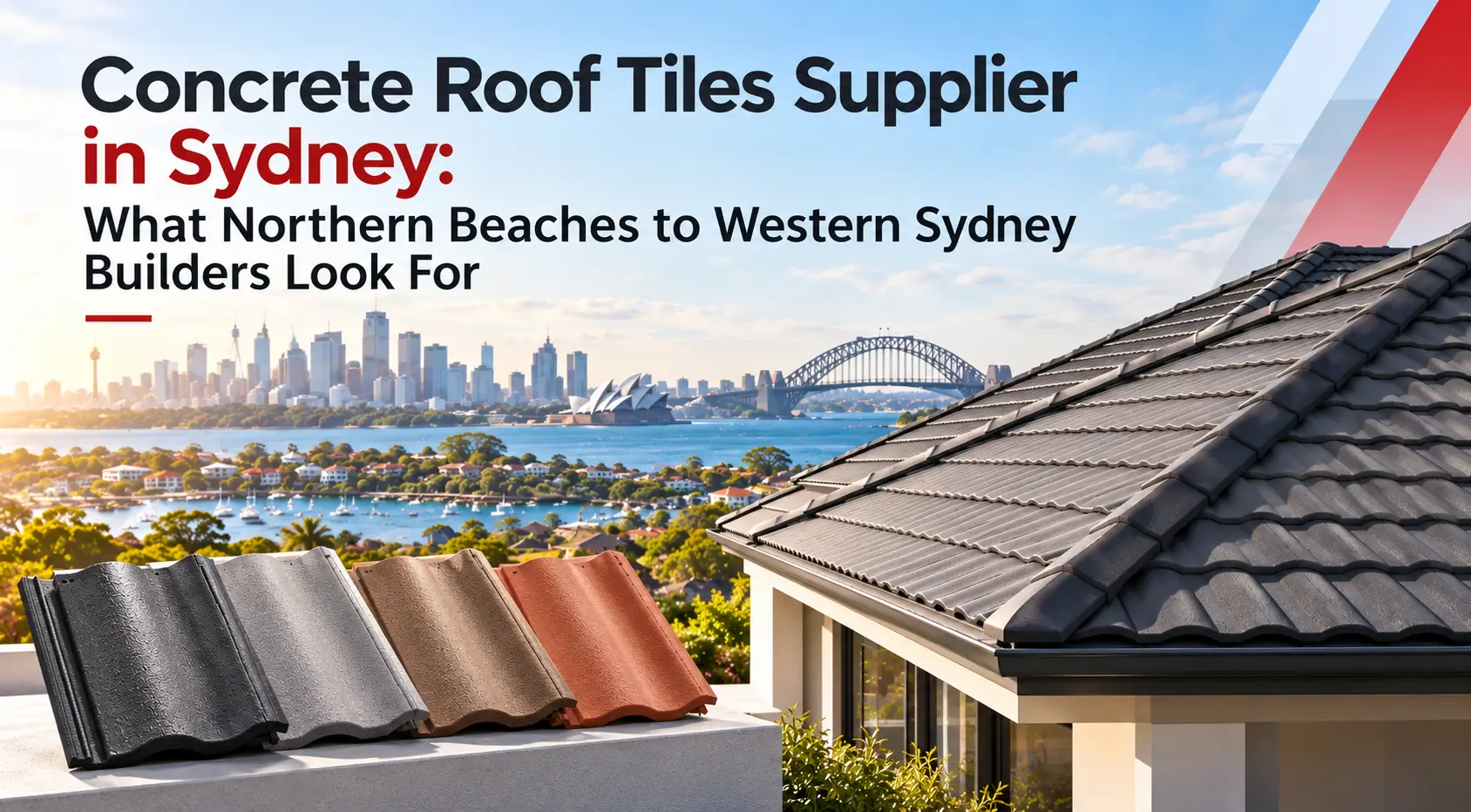
Among the concrete roof tiles types offered by SCG, three distinct personalities define the current lineup. Jewel C delivers classic, bold waves that cast deep, traditional shadows across the roofline. Stepping toward a softer aesthetic, Sadie E offers elegant, subtle curves that smoothly bridge heritage and contemporary styles. For a sleek, minimalist finish, the True Flat mimics a smooth slate tablet, keeping architectural lines sharp and modern.

concrete tile roof maintenance

Concrete Roof Tiles in Melbourne: Lifespan, Cost, and Maintenance Guide

This guide walks through everything you actually need to know before choosing, installing, or maintaining a concrete tile roof: what it costs compared to terracotta, how long it really lasts, how it holds up to bushfire and coastal conditions, what concrete tile installation in Melbourne actually involves, and how to keep the roof looking sharp for decades. Along the way, we’ll also cover what to look for in a concrete roof tile supplier in Melbourne if you’re ready to buy.

Melbourne construction

How SCG Supports Melbourne’s Construction Industry

The construction landscape in Victoria is evolving rapidly. With urban development expanding and residential projects consistently breaking ground, the demand for high-quality construction materials has never been more intense. For businesses operating within this fast-paced ecosystem, securing a robust, agile, and cost-effective supply chain is no longer just an operational goal—it is a critical capability for every building supply distributor.

I’m Here To Assist You

Contact us today

Please read Terms and Conditions, Privacy Notice, Cookies Notice, and I
I acknowledge that I can withdraw the given consent at any time, and I have understood the terms and conditions and how my personal data is processed.