Search

How to Choose a Low Carbon Cement Manufacturer

Share this post :

Facebook
LinkedIn
low carbon cement manufacturer

Key takeaways

"Low-carbon cement" means

Most low-carbon cement strategies work by reducing the clinker factor, improving production efficiency, switching to alternative fuels or energy sources, or blending in supplementary cementitious materials.

Demand verified data, not vague claims

look for a current, third-party EPD with comparable units and life-cycle boundaries, not just a headline reduction number

Performance can't be sacrificed for carbon savings

get strength/durability data and confirm it with your own plant trials, not just supplier lab results

Consistency and supply reliability are critical

shipment variability or unreliable delivery can disrupt production even if the product itself performs well

Judge total value, not price per ton

actor in cement efficiency, project eligibility (LEED/TREES), and access to sustainability-focused bids alongside upfront cost

For concrete producers, choosing a low-carbon cement partner is no longer a simple procurement decision. The right manufacturer helps you lower embodied carbon, qualify for more sustainability-driven projects, protect concrete performance, and keep production predictable. The wrong choice creates mix-design instability, documentation gaps, supply interruptions, or compliance risk.

This guide breaks down the criteria that matter most when evaluating any low-carbon cement manufacturer, and shows, at each step, what a well-established supplier like SCG brings to the table. Low-carbon cement should be judged as both a material and a supply-chain partnership. A product can look attractive on a carbon claim alone, but ready-mix, precast, block, pipe, and infrastructure producers need more than a headline reduction number. They need verified data, dependable structural performance, consistent deliveries, responsive technical support, and a manufacturer that understands how concrete is actually produced at scale, which is exactly the position SCG has built as one of ASEAN’s leading low-carbon cement manufacturers.

What "low carbon cement" means in practical terms

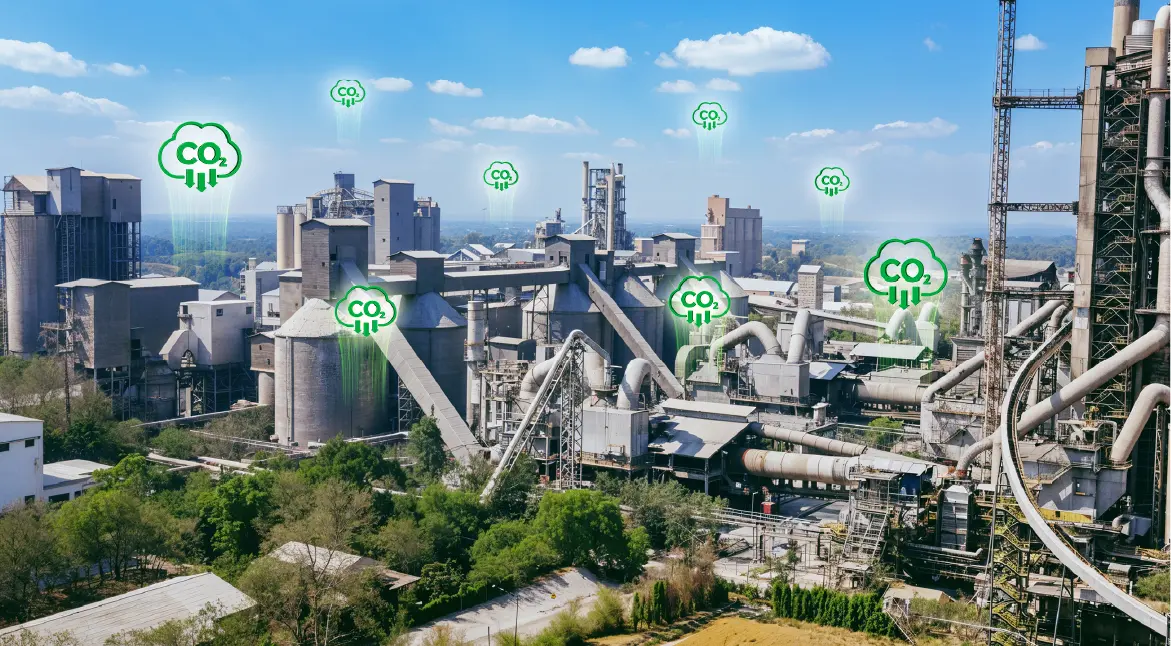
Cement has a high carbon footprint because clinker production requires high-temperature processing of limestone and other raw materials. Emissions come from both fuel combustion and the chemical breakdown of limestone during calcination.

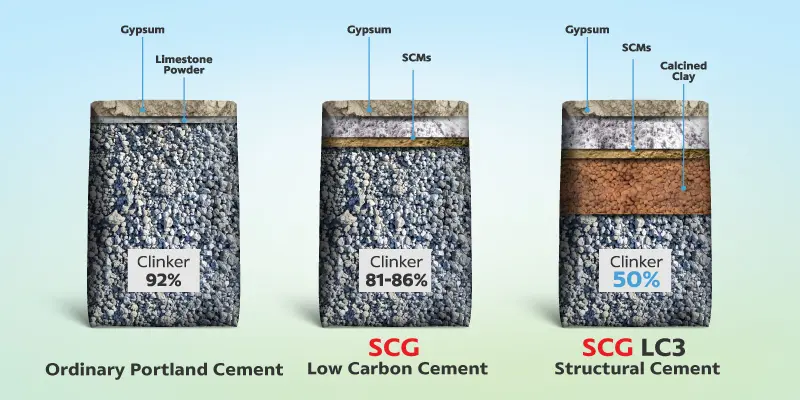
Most low-carbon cement strategies work by reducing the clinker factor, improving production efficiency, switching to alternative fuels or energy sources, or blending in supplementary cementitious materials. “Low carbon” isn’t one single product category, it can mean portland-limestone cement, blended cement, a proprietary structural cement, or a newer binder system entirely, and each behaves a little differently in batching, finishing, curing, and strength gain.

SCG’s approach is a useful benchmark here. SCG Low-Carbon Structural Cement lowers its clinker factor and optimizes raw material use. The result, SCG says, is a cement that reduces CO₂ emissions by up to 20% compared with general structural cement, while still delivering compressive strength equal to or exceeding ordinary structural cement.

Start with your project and mix-design requirements

Before comparing suppliers, define the applications you actually need to serve. A cement that works well for residential slabs may not be the right fit for infrastructure concrete, precast elements, marine exposure, or fast-turnaround production.

Clarify the following before you request quotes:

  1. Required compressive strength and later-age milestones
  2. Exposure classes, sulfate requirements, chloride limits, and freeze-thaw needs
  3. Placement conditions, pumpability, finishability, slump retention, temperature range
  4. Production format: ready-mix, precast, block, pipe, pavers, or site-batched concrete
  5. Applicable cement and concrete standards in your market
  6. Documentation needs, including EPDs, product data sheets, and green building submittals
  7. Your carbon target, whether a project GWP limit or an internal reduction goal

This is where SCG’s product range earns attention: it’s built as a Type 1 Portland-based structural cement suited to columns, beams, slabs, and large structural components, delivering a dense, smooth finish with good flowability, meaning it’s designed to slot into the kind of demanding, structural applications that concrete producers already handle every day, not just light-duty work. 

This step prevents a common mistake: selecting a low carbon cement supplier based on a generic sustainability claim instead of the performance requirements of the concrete you sell.

1. Verified environmental data, not vague claims

A credible manufacturer should be able to hand over environmental documentation that stands up to review, by producers, specifiers, owners, and auditors alike. The most useful document is usually an Environmental Product Declaration (EPD): a standardized, third-party-verified disclosure of a product’s environmental impact.

When reviewing an EPD, look at whether it uses the same product category rules, declared unit, and life-cycle boundary as the alternatives you’re comparing. Ask about the product’s Global Warming Potential (GWP), whether the data is plant-specific, and how current the certification is.

This is a category where SCG is well positioned to compete: its Low-Carbon Structural Cement carries an EPD certified under ISO 14025, is recognized under the SCG Green Choice label, and complies with ASTM, EN 15804, and ISO 21930 standards. 

2. Compliance with cement standards and local specifications

Low-carbon cement still has to satisfy the specifications governing your concrete, ASTM, local building codes, or owner-specific requirements. Don’t assume a low-carbon product is automatically accepted everywhere; some project documents still contain prescriptive cement language.

Due diligence should include confirming the cement’s designation and standard compliance, checking whether it’s accepted by local agencies or owners, and reviewing whether substitutions require engineer approval.

Here, too, SCG’s documentation trail helps simplify the process: because its cement is already certified to ASTM, EN 15804, and ISO 21930, and holds SCG Green Choice recognition, it’s also eligible to contribute credits toward LEED and TREES green building certification, a practical advantage if you’re bidding on projects with sustainability requirements attached.

3. Proven structural performance

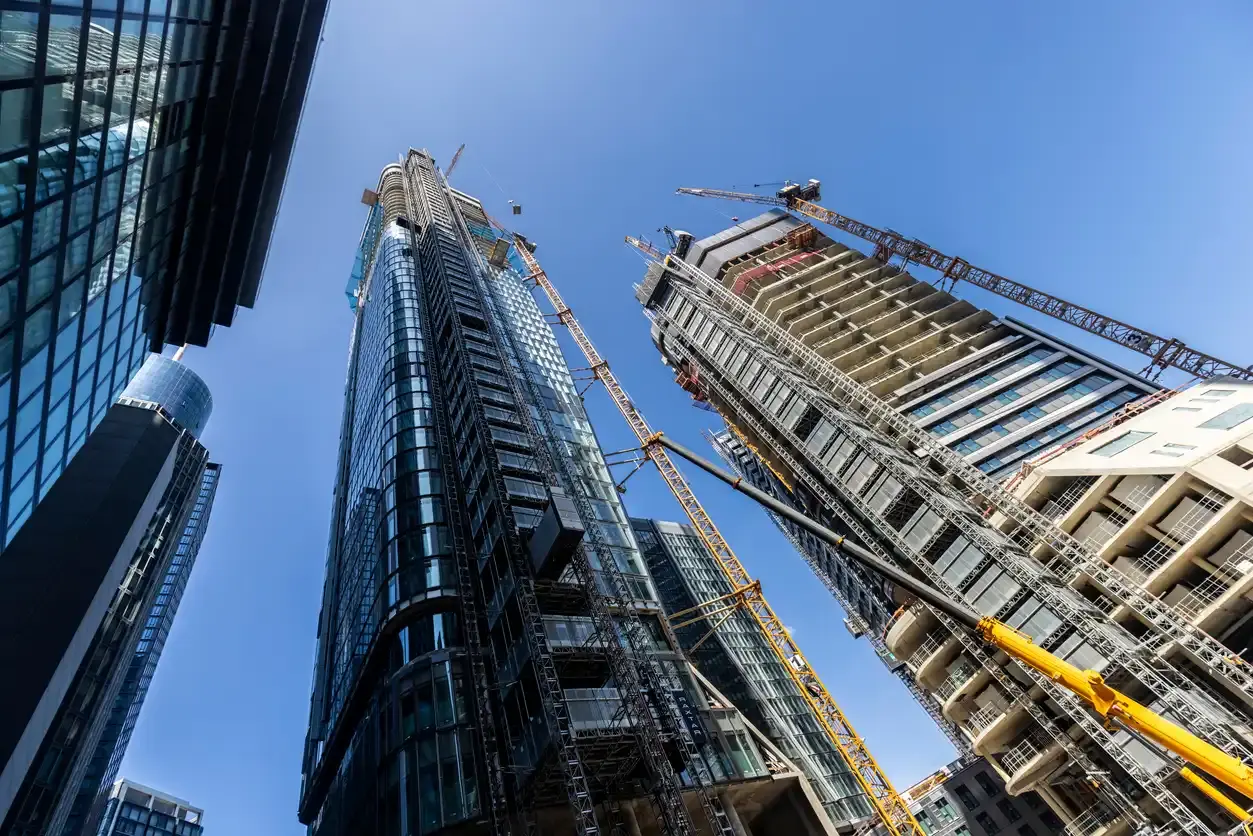
SCG structural cement for high rise building

Carbon reduction can’t come at the expense of strength, durability, or placement reliability. Ask for evidence covering compressive strength development over time, early-age strength, setting time, heat of hydration, shrinkage tendency, and compatibility with common admixtures. Then run your own plant trials, using your own aggregates, admixtures, and conditions, rather than relying only on lab results supplied by the manufacturer.

SCG designs its Low-Carbon Structural Cement specifically to match or exceed the compressive strength of ordinary structural cement, so producers aren’t trading performance for a lower carbon number. It’s positioned for a wide range of structural work, residential, commercial, and infrastructure projects, and SCG highlights long-lasting durability with reduced maintenance needs as one of the product’s core benefits, which can translate into lower lifetime costs for the structures you’re building.

4. Consistency from shipment to shipment

Consistency matters as much as peak performance. A cement with excellent sustainability credentials can still create production problems if fineness, chemistry, set behavior, or strength contribution varies too much between shipments.

Evaluate the manufacturer’s quality-control system. Ask how often the product is tested, what data is included on mill certificates, how deviations are handled, and whether the supplier can provide trend data. For producers with high-volume operations, consistency affects batching accuracy, water demand, admixture dosage, finishing windows, break results, and customer confidence.

5. Supply capacity and logistics reliability

A manufacturer may have a strong product but still be a poor fit if supply is inconsistent. For concrete producers, cement shortages can disrupt production, delay projects, and damage customer relationships.

Assess the supplier’s ability to deliver at your required volume and cadence. Review terminal access, shipping mode, lead times, packaging options, bulk delivery capacity, storage requirements, and contingency plans. If you operate multiple plants, confirm whether the supplier can support all locations with the same product or whether regional differences will require separate mix validations.

A practical supply review should cover:

– Monthly and peak-season volume capacity

– Bulk tanker, bag, container, or vessel options

– Minimum order quantities and lead times

– Backup supply plans

– Inventory buffer recommendations

– Import documentation, if applicable

– Delivery reliability and communication process

– Ability to scale as project demand grows

Low-carbon cement is valuable only if you can source it consistently enough to make it part of your standard offering.
6. Technical partnership, not just sales support

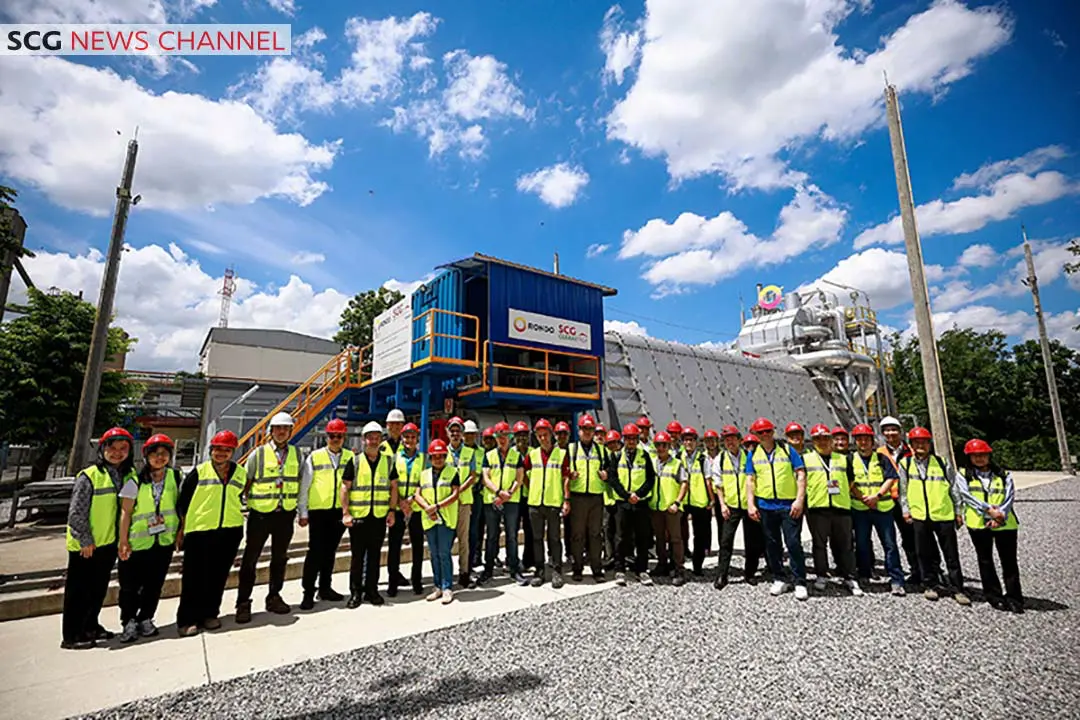
low carbon cement supplier with technical support

The best manufacturers act as technical partners, helping with trial mix planning, admixture compatibility testing, EPD interpretation, and staff training. Your customers will ask why the product works and whether it can meet the same jobsite expectations as conventional concrete, so you need a supplier who can back you up with real technical support, not just a data sheet.

SCG positions its low-carbon cement explicitly as a solution for developers, contractors, and architects who are committed to reducing environmental impact but still need a partner who understands construction specification, which is the kind of collaborative, technically-grounded relationship worth prioritizing in a supplier.

7. Commercial value and total cost

Do not evaluate low-carbon cement by price per ton alone. The real cost depends on cement efficiency, admixture adjustments, batching productivity, rejected loads, strength overdesign, curing time, storage, logistics, customer demand, and the value of qualifying for projects with embodied-carbon requirements.

A slightly higher cement price may be justified if the product helps you:

– Reduce total cementitious content while meeting performance targets

– Win projects with sustainability requirements

– Provide EPD-backed mixes to owners and designers

– Reduce carbon reporting complexity

– Improve differentiation in competitive bids

– Standardize a lower-carbon product line across plants

At the same time, sustainability should not hide poor economics. Ask for transparent pricing, freight assumptions, volume commitments, payment terms, and support for trial material.

8. A clear decarbonization roadmap

A manufacturer’s current product matters, but its future roadmap matters too. Cement and concrete are moving toward lower emissions through clinker reduction, SCM innovation, energy efficiency, alternative fuels, renewable electricity, carbon capture, and improved whole-life design. The Global Cement and Concrete Association’s roadmap frames net-zero concrete as a broad transition involving industry action, technology, policy, and the wider built-environment value chain. (gccassociation.org)

Ask manufacturers how they plan to keep improving. A serious partner should be able to discuss product development, EPD updates, alternative material sourcing, logistics improvements, and support for concrete-level carbon reductions.

Why SCG stands out as a low-carbon cement partner

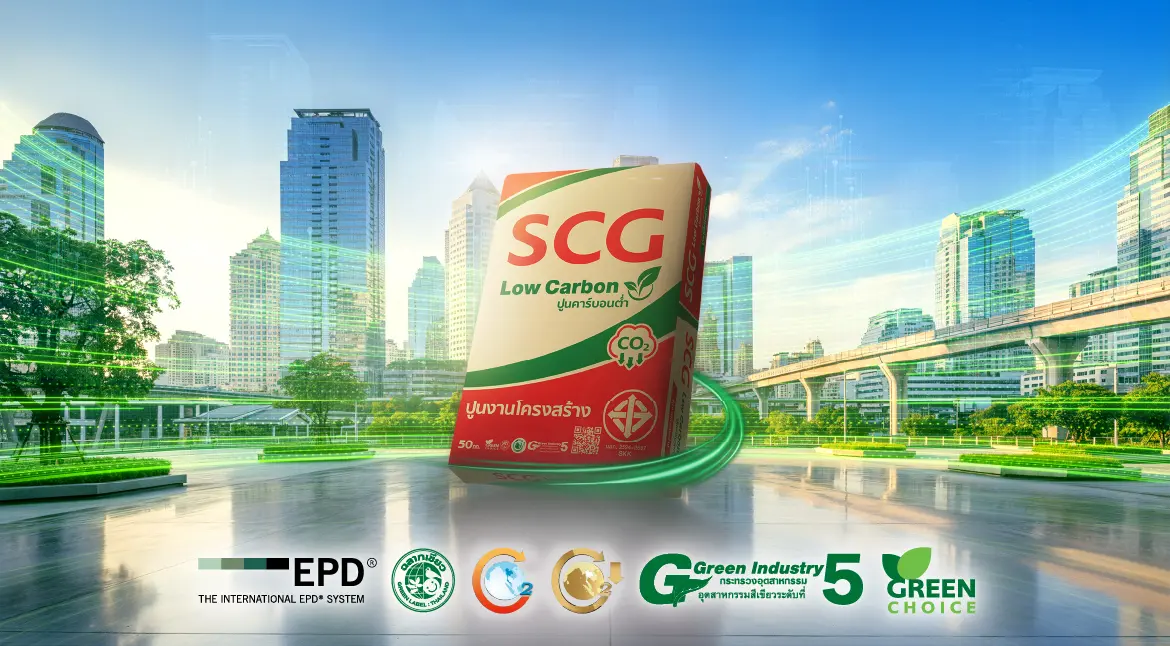
SCG low carbon cement manufacturer

Putting the criteria together, SCG checks the boxes that matter most to concrete producers:

– Verified data: EPD certified under ISO 14025, SCG Green Choice recognition, and compliance with ASTM, EN 15804, and ISO 21930

– Real reduction, not marketing spin: up to 20% lower CO₂ emissions with its current Low-Carbon Structural Cement.

– Performance you can specify with confidence: compressive strength equal to or exceeding ordinary structural cement, built for residential, commercial, and infrastructure work

– Scale and reliability: backed by SCG’s 45+ years of international supply chain expertise, delivering as one of ASEAN’s leading low-carbon cement manufacturers and exporters

– Green building eligibility: contributes toward LEED and TREES certification, simplifying documentation for sustainability-driven projects

SCG low carbon cement mix design

Even so, don’t select any supplier, SCG included, on brand reputation alone. Request the current EPD, confirm the applicable cement designation in your market, review strength and durability data for your applications, and run your own plant trials before committing to volume.

For concrete producers ready to take the next step, SCG Low Carbon Structural Cement brings together verified EPD documentation, proven structural performance, and LEED/TREES eligibility — making it a practical starting point for any low-carbon mix program.

A practical shortlist process for concrete producers

Step 1: Screen the market. Build a list of manufacturers who can serve your geography and volume, including established producers and any low carbon cement supplier with credible documentation.

Step 2: Request a technical package. Ask for a product data sheet, current EPD, safety data sheet, mill certificates, and strength and durability test data.

Step 3: Compare carbon data fairly. Use equivalent units and life-cycle boundaries. A product with lower GWP that requires more cement to hit the same strength may offer a smaller real-world benefit than it appears.

Step 4: Run controlled trials. Start with lab mixes, then plant batches, then a limited project placement, tracking water demand, slump, set time, and strength.

Step 5: Build approved mix designs. Once performance is consistent, add the product to your standard mix library alongside conventional options.

Step 6: Train your team. Make sure dispatch, batching, QC, and sales all understand what’s changed and how to explain it to customers.

Final selection checklist

Before signing a supply agreement, you should be able to answer “yes” to:

  1. Does the cement meet the standards required for your market and applications?
  2. Is the environmental claim backed by a current, third-party verified EPD?
  3. Have you compared GWP on a fair and equivalent basis?
  4. Has the product been tested with your aggregates, SCMs, and admixtures?
  5. Can it meet your required strength, durability, and finishability targets?
  6. Is supply capacity sufficient for normal and peak demand?
  7. Does the manufacturer provide responsive technical support?
  8. Can the supplier support green building documentation like LEED or TREES submittals?
  9. Are pricing, freight, and lead times commercially workable?
  10. Does the manufacturer have a credible roadmap for continued carbon reduction?

Turning supplier selection into a competitive advantage

Low-carbon cement is not just a procurement category. For concrete producers, it can become a platform for new mix designs, stronger customer conversations, and access to projects that prioritize sustainable building materials. The producers who benefit most won’t be the ones simply chasing the lowest cement price, they’ll be the ones who partner with manufacturers offering verified data, proven structural performance, consistent supply, and a genuine long-term commitment to lowering carbon, the kind of profile SCG has built as it scales its low-carbon cement across ASEAN and beyond.

Frequently Asked Questions about low carbon cement manufacturer

Low-carbon typically means reducing clinker-related emissions via clinker factor reduction, production efficiency, alternative fuels/energy, and/or adding SCMs or mineral additions. In practice this can be portland-limestone cement (e.g., Type IL), blended hydraulic cements (per ASTM C595/AASHTO M 240), proprietary structural cements, or newer binder systems. Each behaves differently in batching, finishability, curing, strength gain, heat development, durability, and admixture demand, so you must evaluate the specific product against your applications and mix requirements rather than assuming all low-carbon options are interchangeable.

Ask for a current, verified EPD and compare on equivalent units and assumptions. SCG's EPD is certified under ISO 14025 and backed by ASTM, EN 15804, and ISO 21930 compliance, a useful reference point for what documentation should look like.

Ask for strength, durability, and workability data, then run your own trials. SCG designs its cement to match or exceed the compressive strength of ordinary structural cement, so performance-matching shouldn't require major mix redesign, but you should confirm that with your own materials.

Look at delivery capacity, lead times, and backup plans. Manufacturers backed by established international supply chains, like SCG, through SCG International's 45+ years of logistics experience, tend to offer more predictable sourcing at scale.

Use the same disciplined process you’d apply to any supplier. Request the current EPD and confirm the cement’s designation and standard compliance for your market (e.g., ASTM and EN). Compare GWP on an apples-to-apples basis, review strength and durability data for your exposure classes, test compatibility with your aggregates/SCMs/admixtures, and run staged plant trials. Confirm available volumes, lead times, and logistics for all your plants if applicable. Treat brand claims (e.g., up to 20% CO₂ reduction) as starting points to be verified with current documentation and your own performance and supply evaluations.

Related Posts

concrete tile roof maintenance

Concrete Roof Tiles in Melbourne: Lifespan, Cost, and Maintenance Guide

This guide walks through everything you actually need to know before choosing, installing, or maintaining a concrete tile roof: what it costs compared to terracotta, how long it really lasts, how it holds up to bushfire and coastal conditions, what concrete tile installation in Melbourne actually involves, and how to keep the roof looking sharp for decades. Along the way, we’ll also cover what to look for in a concrete roof tile supplier in Melbourne if you’re ready to buy.

Melbourne construction

How SCG Supports Melbourne’s Construction Industry

The construction landscape in Victoria is evolving rapidly. With urban development expanding and residential projects consistently breaking ground, the demand for high-quality construction materials has never been more intense. For businesses operating within this fast-paced ecosystem, securing a robust, agile, and cost-effective supply chain is no longer just an operational goal—it is a critical capability for every building supply distributor.

new-build-concrete-roof-tile

Where to Buy SCG Concrete Roof Tiles in Australia

Among the concrete roof tiles types offered by SCG, three distinct personalities define the current lineup. Jewel C delivers classic, bold waves that cast deep, traditional shadows across the roofline. Stepping toward a softer aesthetic, Sadie E offers elegant, subtle curves that smoothly bridge heritage and contemporary styles. For a sleek, minimalist finish, the True Flat mimics a smooth slate tablet, keeping architectural lines sharp and modern.

I’m Here To Assist You

Contact us today

Please read Terms and Conditions, Privacy Notice, Cookies Notice, and I
I acknowledge that I can withdraw the given consent at any time, and I have understood the terms and conditions and how my personal data is processed.