Search

Choosing the Right Type of Biomass Boiler Fuel

Share this post :

Facebook
LinkedIn
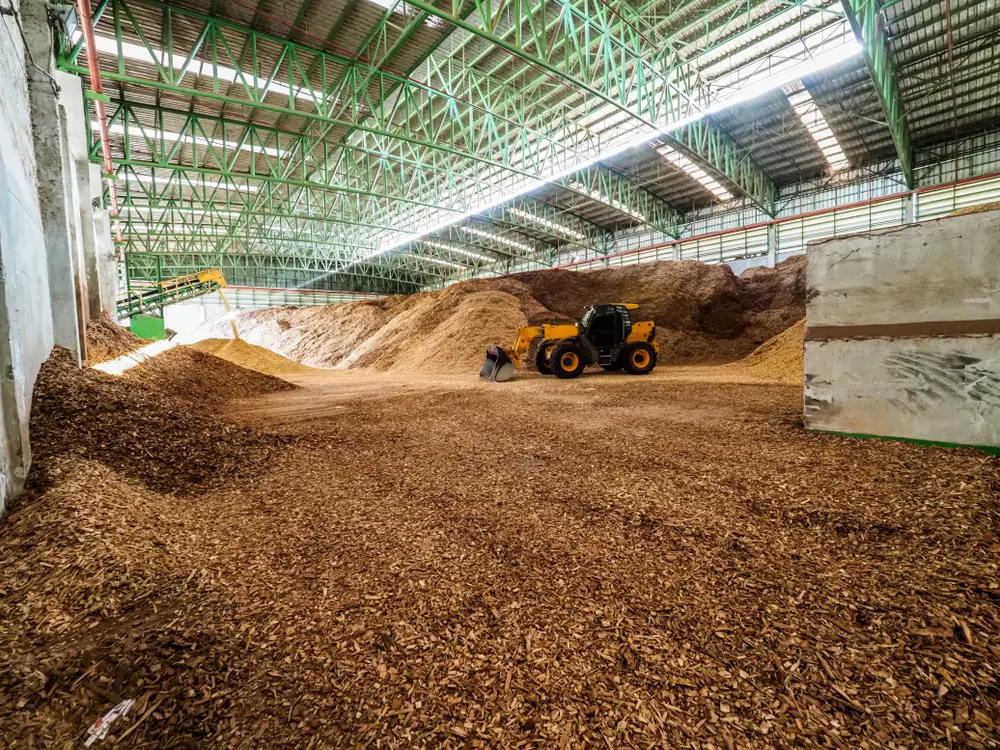
SCG International sources wood materials, such as wood chips, for biomass fuel use

Key takeaways

Biomass boiler fuel is divided into three broad categories

wood material, agricultural residues, and energy crops.

The right biomass boiler fuel types depend on boiler design

feeding system, and emission controls, not just calorific value.

Ash behavior, moisture, and particle size

drive most of the real-world differences between biomass boiler fuel options.

SCG International sources a diversified range of biomass boiler fuel types

and pairs supply with boiler tuning and emissions support.

Table of Contents

Industrial operators moving to greener fuel are increasingly turning to biomass boiler fuel for lower net carbon emissions, more predictable costs, and long-term ESG alignment. Choosing the right fuel is not a simple swap. It depends on boiler design, local supply availability, moisture and ash tolerance, and the consistency of fuel specifications from shipment to shipment. Buyers often struggle to select biomass boiler fuel types because wood-based fuels, agricultural residues, and energy crops behave very differently once they enter the combustion chamber. 

This guide breaks down the main biomass boiler fuel types, how they compare, and what to look for when securing a reliable long-term supply. Getting the fuel choice wrong is rarely a minor issue: mismatched fuel and boiler design tends to show up later as unplanned downtime, higher maintenance costs, or ash-related trips that are expensive to trace back to the source.

What Is Biomass Boiler Fuel?

Biomass boiler fuel refers to organic, renewable materials burned in dedicated biomass boilers or co-fired with existing fuel to generate heat, steam, or power. As a renewable source, it produces lower net CO2 than existing fuels and often makes productive use of by-products that would otherwise go to waste. The trade-off is practical rather than chemical. Biomass fuels require bulk handling infrastructure, ongoing ash management, and consistent moisture and particle size to keep combustion stable, which is why fuel selection has to be matched carefully to a plant’s existing equipment.

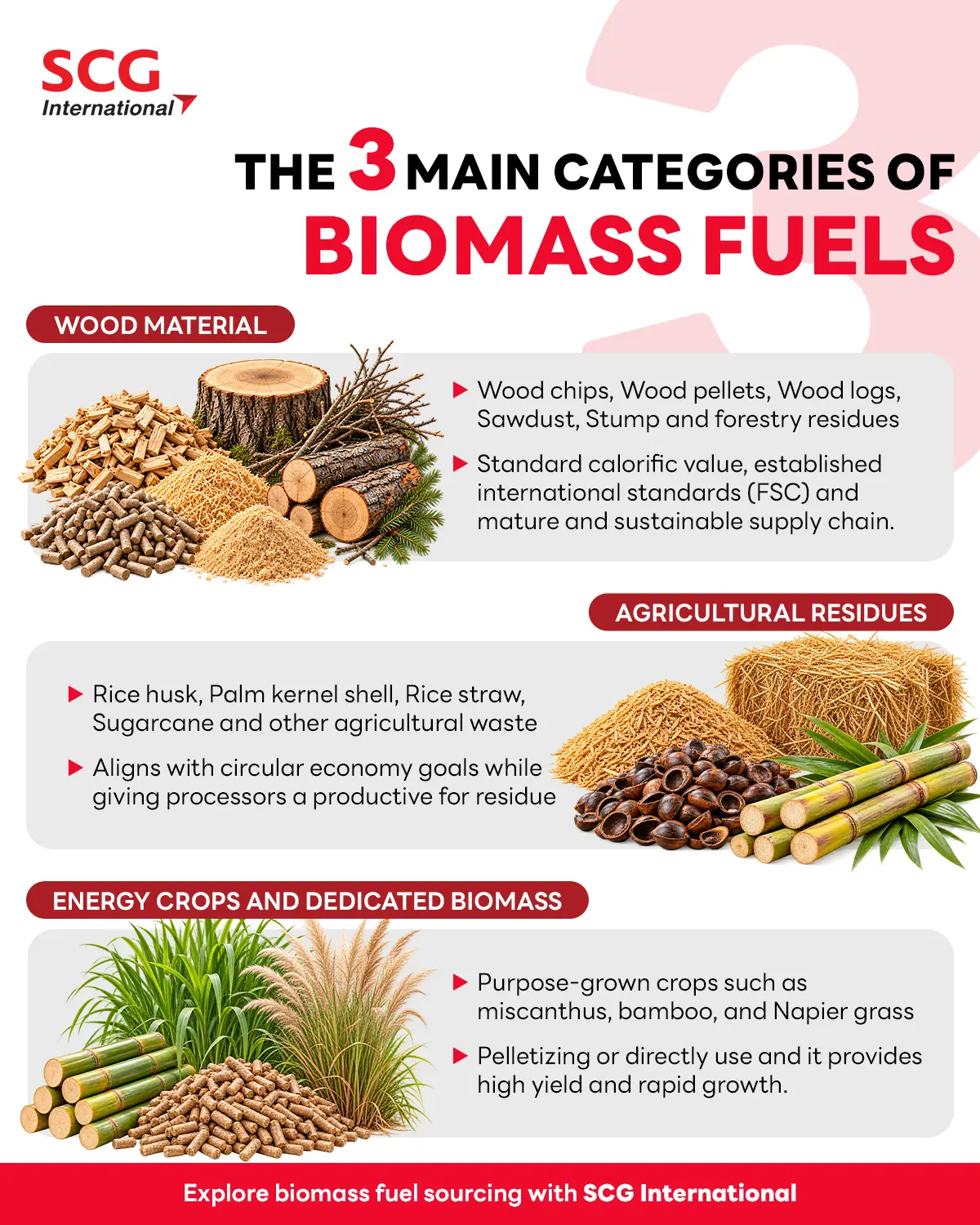
The 3 Main Types of Biomass Fuels

Most industrial biomass boiler fuel falls into four broad categories, and each behaves differently in a boiler.

1. Wood Material

Wood chips, pellets, logs, sawdust, bark, and forestry residues make up the largest global category of biomass boiler fuel. It is popular for its predictable calorific value, established international standards, and mature, well-developed supply chains.

2. Agricultural Residues

Crop by-products such as rice husk, rice straw, palm kernel shell, corn cob, and sugarcane trash turn agricultural waste into usable fuel, aligning with circular economy goals while giving processors a productive outlet for residue that would otherwise be burned or discarded.

3. Energy Crops and Dedicated Biomass

Purpose-grown crops such as miscanthus, bamboo, and Napier grass, usually pelletized before use, offer high yield and fast growth. These crops are increasingly built into long-term decarbonization plans where supply predictability matters as much as combustion performance.

What Fuel Does a Biomass Boiler Use?

The specific fuel a biomass boiler uses depends on its design, feeding system and emission controls. But most industrial and commercial systems draw from a few fuel types.

1. Wood Pellets

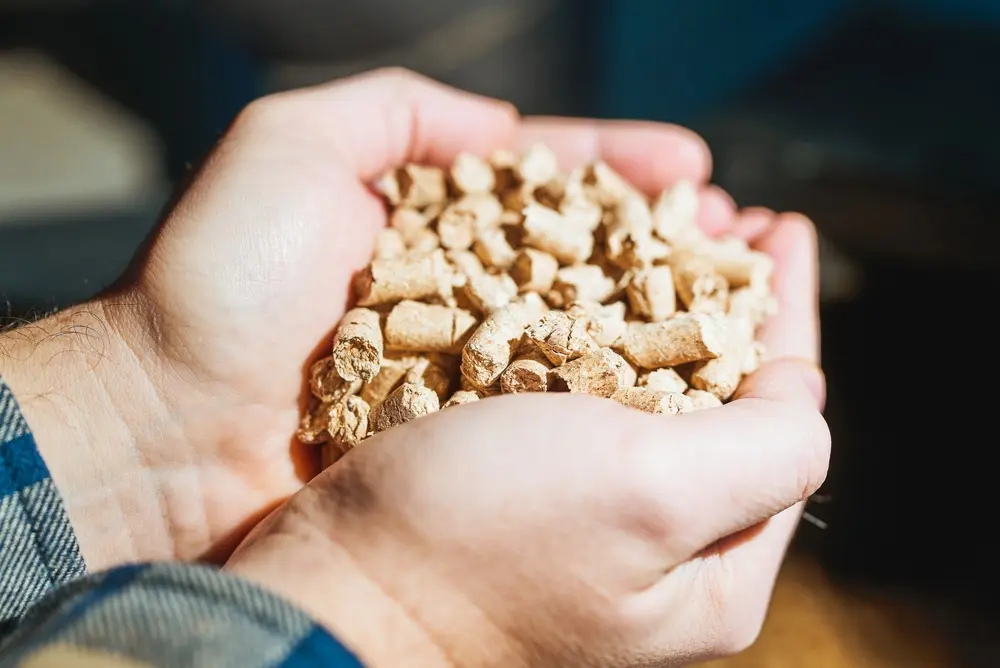
Uniform in size and low in moisture, wood pellets offer high energy density and are best suited to automated systems where space, emissions, and combustion stability all matter.

2. Wood Chips

Chipped forestry or recycled wood carries higher moisture and a larger particle size than pellets. It typically costs less as a fuel but requires more robust handling and storage infrastructure to manage consistently.

3. Wood Logs and Residues

Batch-fed logs, bark, and sawdust suit small-scale or rural setups well, but they are rarely used in large industrial operations due to handling and consistency constraints.

Agricultural Biomass Fuels for Industrial Boilers

Agricultural residues extend the range of biomass boiler fuel types available to industrial buyers, particularly in regions where a specific crop dominates local agriculture.

1. Palm Kernel Shell (PKS)

A dense, low-moisture by-product of palm oil processing, PKS is favored in industrial boilers and coal co-firing for its strong calorific value, storability, and established trade flows.

2. Rice Husk and Rice Straw

Rice husk is widely used in rice mills and biomass power plants, while rice straw is increasingly pelletized to replace open-field burning. Both carry silica-rich ash and some slagging risk, so they are typically burned in specialized grate boilers built to handle that ash profile.

3. Corn Cob, Sugarcane Residues, and Other Crop Fuels

Once pelletized, these residues become stable fuels that are common in regions where the underlying crop is dominant, and they can undergo co-firing in properly tuned industrial boilers.

4. Bamboo and Napier Grass Pellets

These fast-growing energy crops carry a relatively high calorific value, making them a strategic option for plants planning long-term biomass sourcing rather than a one-time fuel swap.

Comparing Biomass Boiler Fuel Options

Selecting among biomass boiler fuel types comes down to three practical factors.

1. Energy Content, Moisture, and Combustion

Calorific value and moisture content vary meaningfully between pellets, chips, PKS, and agricultural pellets, and that variation directly affects boiler efficiency, turndown ratio, and how well a system automates.

2. Ash, Emissions, and Maintenance

Wood-based and agro-based biomass differ in ash content and composition, which changes the fouling, slagging, and particulate emissions a plant needs to plan for, along with maintenance intervals.

3. Fuel Handling, Storage, and Safety

Bulk density, flowability, dust explosion risk, and weather protection all vary by fuel type, so the fuel choice needs to match the handling infrastructure already in place, not the other way around.

Matching Fuel to Biomass Boiler Type

The right biomass boiler fuel depends heavily on the boiler system itself.

1. Small and Medium Commercial Boilers

These systems typically rely on wood pellets or high-quality chips, since both support automation and consistent emission control.

2. Industrial Grate and Fluidized Bed Boilers

These systems can handle a broader fuel mix, including PKS, rice husk, and agricultural pellets. Fluidized bed systems in particular offer the widest fuel flexibility once properly tuned.

3. Co-Firing with Coal

In co-firing setups, biomass replaces part of the existing fuel to reduce net CO2 emissions. Uniform, higher-density fuels such as black pellets or PKS tend to suit existing fuel handling systems best

Transitioning from Coal to Biomass in Industrial Boilers

1. Selecting Coal Replacement Fuels

Evaluation should weigh net calorific value, grindability or size, ash behavior, and compatibility with existing handling systems. Black pellets, PKS, and agricultural pellets are among the fuels already used in conversion projects.

2. Boiler Tuning, Monitoring, and Operator Training

Combustion tuning and real-time monitoring help stabilize performance across fuel grades, and operator training is often the most overlooked step in a successful coal-to-biomass transition.

3. Emission Compliance and Ash Management

Biomass typically lowers SOx and net CO2 emissions, though particulate levels can vary depending on fuel type, moisture, and combustion settings. Emission testing and ash analysis become part of ongoing operations rather than a one-time check.

Ensuring Reliable Biomass Boiler Fuel Supply

1. Why Consistent Specifications Matter

Stable moisture, particle size, and net calorific value reduce boiler trips and clinker formation, and origin-based quality control testing is a key safeguard against inconsistent shipments.

2. Multi-Source and Multi-Region Sourcing

Diversified sourcing across countries and suppliers protects against seasonal crop changes, policy shifts, and logistics disruptions, which matters most for plants running base-load steam or power.

3. Working with Biomass Boiler Suppliers and a Global Sourcing Partner

Professional biomass boiler suppliers and fuel sourcing partners play a role in supplier vetting, quality control, logistics, and documentation. Buyers increasingly look for a professional sourcing partner company that pairs fuel supply with boiler readiness assessment and tuning support, since that combined approach tends to hold up better across multiple sourcing cycles than fuel supply alone.

How SCG International Supports Industrial Biomass Fuel Sourcing

SCG International brings more than 40 years of experience in procurement and supply chain business, supported by a business network across 50 countries, to industrial biomass boiler fuel sourcing. On-ground sourcing teams across Asia, the Middle East, Africa, and Oceania support supplier verification and quality control at origin. SCG International sources a diversified range of biomass boiler fuel types, including shredded wood, wood pellets, black pellets, palm kernel shell, rice husk, rice straw, corn cob, bamboo biomass, sugarcane leaf pellets, and Napier grass, through verified regional suppliers. 

Beyond sourcing, SCG International coordinates quality inspection, documentation, bulk vessel chartering, multimodal transport, buffer stock planning, and seasonal supply forecasting to keep base-load operations stable. Quality control at origin typically includes testing for moisture content, particle sizing, and net calorific value before shipment, so plants receive a more standardized biomass boiler fuel supply. Through its Green Business Solutions expertise, SCG International also supports industrial customers pursuing decarbonization and coal-to-biomass transition goals, including boiler consultation, combustion optimization, emission testing, and ash handling guidance.

The four main biomass boiler fuel types each bring different handling, ash, and combustion characteristics, and the right choice depends on boiler design, fuel availability, and how the plant plans to scale. The right fuel paired with a resilient sourcing strategy determines whether a biomass program stays a pilot project or scales into a portfolio-wide decarbonization lever.

Discuss your biomass fuel sourcing requirements with SCG International to explore how its team can support your plant’s transition and long-term operational stability.


Frequently Asked Questions About Biomass Boiler Fuel Types

The 3 main categories are woody biomass (wood chips, pellets, and forestry residues), agricultural residues (rice husk, rice straw, palm kernel shell, and corn cob) and energy crops such as miscanthus, bamboo, and Napier grass.

Most industrial and commercial biomass boilers use wood pellets, wood chips, or agricultural pellets such as palm kernel shell and rice husk, with the specific choice depending on the boiler's design, feeding system, and emission controls.

Biomass boiler fuel options range from wood pellets, wood chips, and logs to agricultural residues like rice husk, rice straw, corn cob, and sugarcane trash, plus energy crops such as bamboo and Napier grass, each suited to different boiler types and combustion conditions.

Related Posts

Business partners reviewing logistics and inventory for OEM sourcing

The 7-Step OEM Sourcing Process For B2B Manufacturers

When component compatibility, safety, and reliability are paramount for manufacturers, opting for generic sourcing can lead to hidden expenses that eclipse a cheaper unit cost. OEM procurement addresses this by structuring how companies source parts and finished goods directly from the original equipment manufacturer, to specifications the buyer owns or controls.

Bulk cement discharged at a U.S. port terminal by global cement supplier SCG International

What Is EPD Cement? Why This Certification Matters for Modern Cement Buyers?

EPD cement is cement whose environmental performance has been measured by life cycle assessment, documented in an Environmental Product Declaration, and verified by an independent third party under ISO 14025. An EPD does not mean the cement is “green.” It means the carbon number attached to that cement is auditable

Organic Coconut Water Supplier Saudi Arabia: A Sourcing Guide for GCC Buyers

Organic coconut water from Thailand can give Saudi supermarkets and GCC distributors another option within imported, natural, and ready-to-drink beverage ranges. This guide is designed for retail buyers, importers, category managers, and foodservice teams planning a natural coconut drink retail Saudi Arabia programme or evaluating supply for other GCC markets.

SCG Green Batts insulation products for a reliable green batts supplier in Sydney, Australia.

Green Batts Supplier in Sydney: A Guide to Sourcing Consistent Insulation Stock

Sourcing insulation should not slow down a build, delay a retail order, or leave your team chasing uncertain stock. If you need a dependable green batts supplier in Sydney, the goal is more than finding a product at the right price. You need consistent Glasswool batts, clear product information, responsive communication, and supply planning that matches real project demand.

I’m Here To Assist You

Contact us today

Please read Terms and Conditions, Privacy Notice, Cookies Notice, and I
I acknowledge that I can withdraw the given consent at any time, and I have understood the terms and conditions and how my personal data is processed.