The global corn starch market is experiencing rapid growth with promising expansion ahead. According to the “Corn Starch Market Size and Share Analysis – Growth Trends and Forecast Report 2025-2033” by Research and Markets, the corn starch market reached $21.99 billion USD in 2024 and is projected to reach $43.74 billion USD by 2033, with a compound annual growth rate of 7.94%. This corn starch procurement trend makes corn starch a crucial raw material driving business sectors across various industries, including food, beverages, pharmaceuticals, and biomaterials. However, this increased demand comes with increasingly complex procurement challenges, especially in an era where global volatility affects supply chains, potentially causing corn starch supply issues and eventual supply continuity problems.
Global Events Impacting Supply Chains
Recent years have witnessed numerous global situations affecting supply chains and causing corn starch supply issues, including:
Uncertainties from Wars and Political Tensions
China-US Trade Tensions : Trade tensions between China and the United States significantly impact the global corn starch market, as both countries are key players in the worldwide corn market. Fluctuating trade policies and import tariffs directly affect raw material prices and accessibility, while uncertainty in trade agreements forces businesses to face risks in long-term business planning.
Russia-Ukraine War : The Russia-Ukraine conflict is another critical factor affecting corn starch supply chains. This conflict not only impacts corn production in Eastern Europe but also increases transportation and energy costs globally, consequently raising corn starch production costs worldwide.
Climate Change and Agricultural Impact
Climate change severely affects corn cultivation areas worldwide, particularly frequent droughts and floods in the southwestern United States and Brazil – major global corn producers. Severe climate variations create corn starch supply issues with continuity problems due to increasingly uncertain corn yields.
Additionally, farmers must adapt to climate change by switching corn varieties and adopting new cultivation methods. While this adaptation helps address climate challenges, it affects corn quality and yield, making supply chains more volatile.
Changing Market Dynamics in Asia
India’s changing role in the global market significantly impacts corn starch supply chains. The country has transformed from a major corn exporter to an importer due to aggressive government ethanol production policies aimed at reducing oil import dependence. This shift rapidly increased domestic corn demand in India, reducing global corn supply and driving prices higher.
Corn Starch Procurement Trends and Factors Increasing Production Costs
Rising Raw Corn Prices
Raw corn prices continue rising due to multiple factors, particularly demand from the animal feed industry as the main driver, especially growth in Asia’s livestock sector. Meanwhile, the expanding ethanol industry, following clean energy policies, draws corn supply away from food markets. Combined with reduced cultivation areas from climate change, supply tightens and prices rise accordingly.
Higher Energy and Logistics Costs
Corn starch production requires high energy from starch separation to drying processes. When oil and natural gas prices rise, production costs increase accordingly. Additionally, sea transportation costs have risen dramatically from global crises and container shortages, significantly increasing import-export costs.
Demand from New Industries
The rapidly growing bioplastics industry drives higher corn starch demand as a main raw material for biodegradable plastic production. Environmental awareness trends and stringent regulations fuel this industry’s global expansion. Simultaneously, functional foods and clean label products require more high-quality modified corn starch, creating raw material competition between industries and driving corn starch prices higher with increased demand.
SCG International : Your Reliable Partner for Corn Starch Procurement
In an era where uncertainty becomes normal, SCG International not only supplies quality corn starch meeting standards but also supports customer businesses and production across multiple countries to continue operating despite market volatility, with flexible supply chain networks ready to respond appropriately to demands.
Diverse Corn Starch Grades : Native and Modified Corn Starch
To meet diverse industry demands, SCG International supplies both main corn starch types:
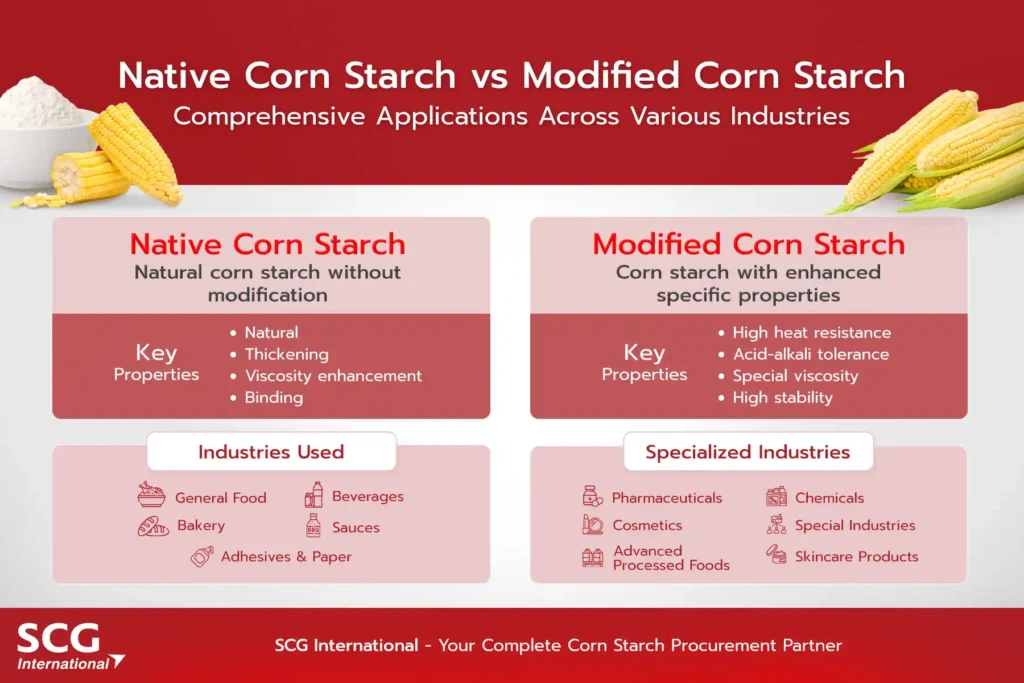
Native Corn Starch: Natural corn starch without modification, suitable for basic applications in the food and paper industries, such as thickening, viscosity enhancement, and binding.
Modified Corn Starch: Corn starch with enhanced specific properties like high heat resistance, acid-alkali tolerance, or special viscosity, suitable for specialized industries, including pharmaceuticals, cosmetics, and advanced processed foods.
Beyond corn starch, we also specialize in tapioca/cassava starch procurement with quality advantages, providing diverse options for different applications.
Global Supplier Network Reduces Supply and Corn Starch Procurement Issues
With a supplier network covering over 50 countries and long-term relationships with leading global producers, we access high-quality corn starch sources from diverse regions.
A globally distributed supplier network is key to supply risk management. When one production source faces problems – whether from climate change, political conflicts, or technical issues – the ability to promptly source from alternatives ensures uninterrupted business operations.
Additionally, diverse quality supplier options enhance price negotiation power while maintaining consistent starch quality through high-standard supplier selection.
Expert Teams Understanding Markets Help Manage Risks
SCG International has expert teams with a deep understanding of global corn starch procurement trends, comprehensively supporting business operators’ needs:
Select appropriate suppliers by carefully considering three main factors: competitive pricing, standard-meeting quality, and acceptable risk levels
Strategic planning in advance helps customers effectively reduce price volatility risks through accurate market analysis and price trend forecasting
Provide information and advice to help customers manage potential risks, including weather, political, and supplier status issues
Integrated Supply Chain Management Support
1) Quality control throughout the procurement and transportation processes with consistent monitoring approaches, ensuring delivered products meet specified standards
2) Support cost-effective and reliable transportation through appropriately selected service providers in each area, enhancing flexibility and reducing transportation costs
3) Document management and compliance with each country’s regulations – our team has expertise in international trade regulations, ensuring smooth and legally compliant import-export processes
Don’t let uncertainty hinder your business growth. Choose a global corn starch and tapioca starch supplier like SCG International. Contact us today to discuss corn starch and tapioca starch procurement solutions suitable for your business, with expert team consultation understanding markets and your needs thoroughly.
Starch is a key raw material used to produce products in various industries, especially tapioca starch, which plays an important role in the production of adhesives, textiles, biodegradable materials, and paper, as well as in food products like pasta, snacks, instant foods, semi-finished foods, sweeteners, and even medical products.
Although the flooring and tile industry has shown continuous growth post-pandemic, driven by increased investment in both public and private construction projects, as well as rising home renovation demands, businesses still face intense competition. This includes competing on material quality, offering a wide range of choices to customers, and competing against low-quality, low-priced products. Construction businesses cannot gain a competitive edge over others without a robust and comprehensive supply chain for flooring and tiles.