

Search

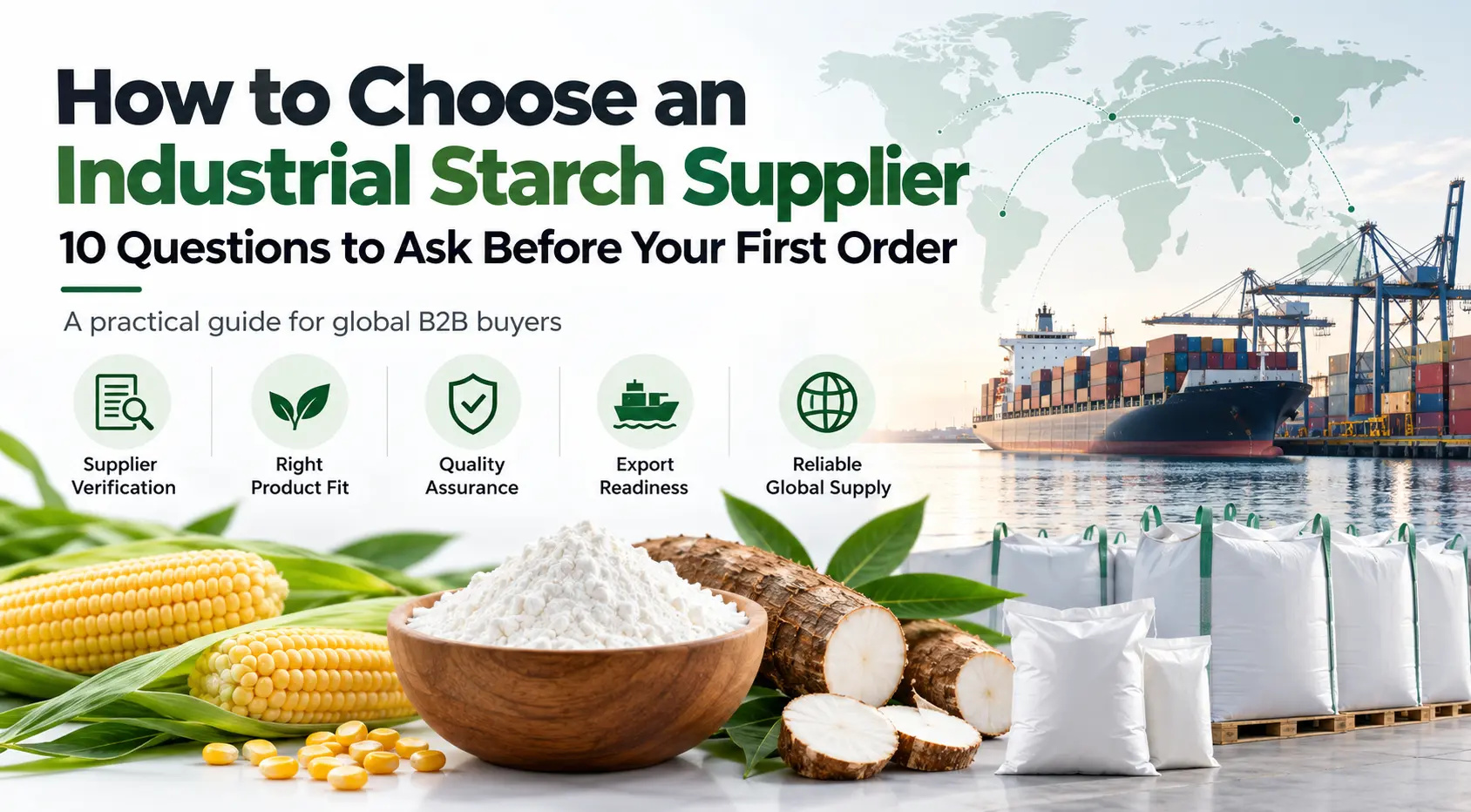
How to Choose an Industrial Starch Supplier: 10 Questions to Ask Before Your First Order

Share this post :

Facebook
LinkedIn
How to choose starch supplier

The lowest quote can become the most expensive choice when a starch grade fails in production, customs hold up the shipment, or batch output changes without warning. A dependable industrial starch supplier should be judged on product fit, plant controls, tracking, export skill, and supply continuity, not price alone.

The same rules apply whether you are dealing with a corn starch supplier, a tapioca starch supplier, or a modified starch supplier.

Before you approve your first order, use these ten questions to compare suppliers on the same basis. The goal is simple: choose a starch that works in your process and a supply partner that can keep it moving across borders.

1. How Do You Verify an Industrial Starch Supplier?

Start by confirming the supplier’s legal name, real plant site, quality history, and payee. Check whether you are buying from a maker, distributor, or trading company. A sourcing partner can add value, but accountability must stay clear: who makes the starch, releases each batch, manages documents, and handles complaints?

Build a supplier review file that includes:

  • – Registered company name, address, plant location, and verified bank details.
  • – Relevant certificates, product specs, sample batch records, and examples of corrective action.
  • – A lot tracking record linking a finished lot to production and raw-material records.
  • – Proposed production schedule, export responsibilities, capacity data, and customer references where available.

Pause the process when the quote, certificate, plant address, or bank information does not match. These are risk signs to fix before payment, not admin details to sort out later.

2. Which Type of Starch Fits Your Application?

The right choice depends on both the botanical source and the function you need. Corn, tapioca or cassava, wheat, and potato name the source. Native, pre-cooked, and modified describe the process or function. These categories can overlap, so modified tapioca starch is a valid product type.

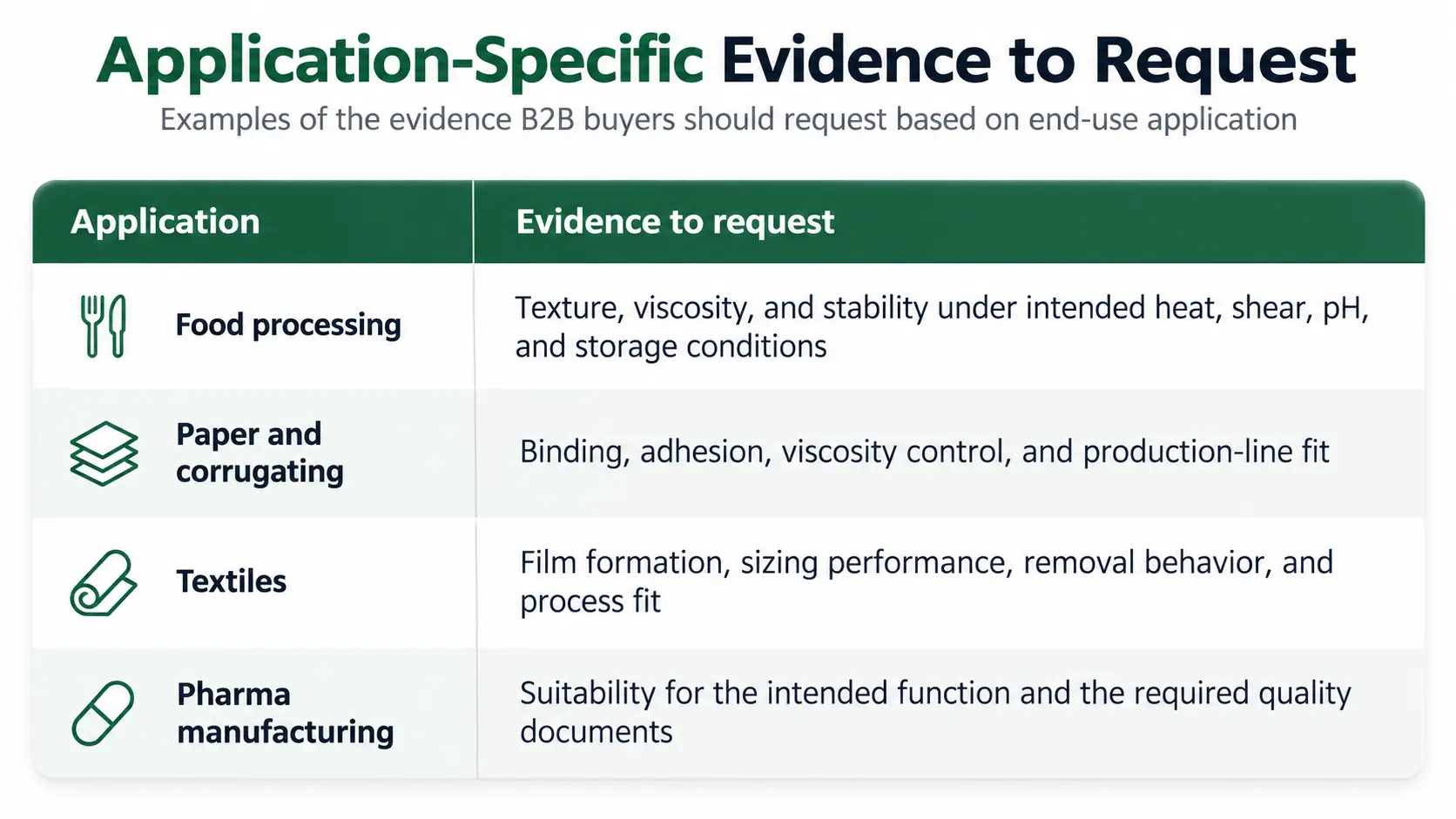
Give possible suppliers an application brief that covers process temperature, mixing conditions, solids level, target viscosity, storage conditions, and the problem you want to solve. Ask for a grade recommendation tied to those conditions rather than a general promise of ‘premium quality’.

3. Native or Modified Starch: Which One Should You Choose?

Consider modified starch when a native grade cannot reliably deliver the needed process behavior or finished-product performance. Depending on the grade, a change may improve viscosity stability, adhesion, film formation, drying behavior, freeze-thaw stability, or function without cooking.

Ask the modified starch supplier to define the grade’s intended function, prep method, dose range, and operating limits. Then run a side-by-side trial against your current formula or a clear baseline. Record dose, process settings, prep steps, and acceptance criteria. Approve the result you can prove, not the category name.

4. Should You Choose a Starch Supplier in Thailand?

Thailand should be part of the review if you need an industrial starch supplier in Thailand for tapioca starch, but origin alone does not prove fit. Check each plant and compare it with options in Vietnam, India, China, or other sourcing markets using the same technical, quality, commercial, and logistics criteria.

Keep two reviews separate:

  • – Factory review: product performance, process controls, tracking, complaint handling, and available capacity.
  • – Supply-route review: freight, payment risk, transit assumptions, customs prep, and backup options.

Ask each supplier how it would react to late sailings, raw-material shortages, or production stops. The real comparison is between checked supply plans, not country reputation.

5. Which Certifications and Quality Assurances Matter?

Request certificates that fit the intended use, plant activity, destination market, and your customer requirements. For food starch, this may include certification under an applicable GFSI-recognized programme. Remember that GFSI recognizes certification programmes; it does not certify factories itself.

For every certificate, check the named site, scope, current status, expiry date, and certification body. Keep certification separate from product approval. A certificate supports supplier review, but it does not prove that a specific grade will work in your process or that every shipment meets your agreed spec.

For special uses, ask your quality or regulatory team to define the needed evidence before quotation. Avoid treating broad labels such as ‘food grade’ or ‘industrial grade’ as a full review package.

6. What Should You Test Before the First Bulk Order?

Agree on a written specification and test representative production samples before you commit to bulk volume. As a practical first step, request samples from at least two separate production batches, then expand sampling if risk or trial results justify it.

Define four areas before testing:

  • – Identity and composition: botanical source, grade name, and relevant composition requirements.
  • – Physical performance: agreed viscosity method, prep conditions, and functional acceptance limits.
  • – Safety and compliance: tests chosen through an application-specific hazard and regulatory review.
  • – Batch documents: lot ID, actual results, methods used, and release approval.

Combine lab checks with a production-relevant trial. Also agree in advance how disputed results will be reviewed, including sampling method, retention samples, and the lab used for confirmation.

7. What Import Requirements Apply to the Shipment?

Import requirements depend on destination, product identity, composition, and intended use. For U.S. food imports, find out whether the Foreign Supplier Verification Programs rule applies and identify the importer responsible for the required actions. Food-specific rules should not automatically be applied to every industrial starch shipment.

For other destinations or non-food uses, ask your customs broker and regulatory specialist to confirm tariff code, entry rules, labeling, registrations, and use-specific needs. Give them the exact composition and intended use rather than asking about ‘starch’ in general.

Assign duties before booking cargo. The supplier, broker, importer, freight forwarder, and quality team should all know their roles. They must understand what to provide, review, submit, and approve.

8. Which Export Documents Should Be Ready Before Dispatch?

Starch export document

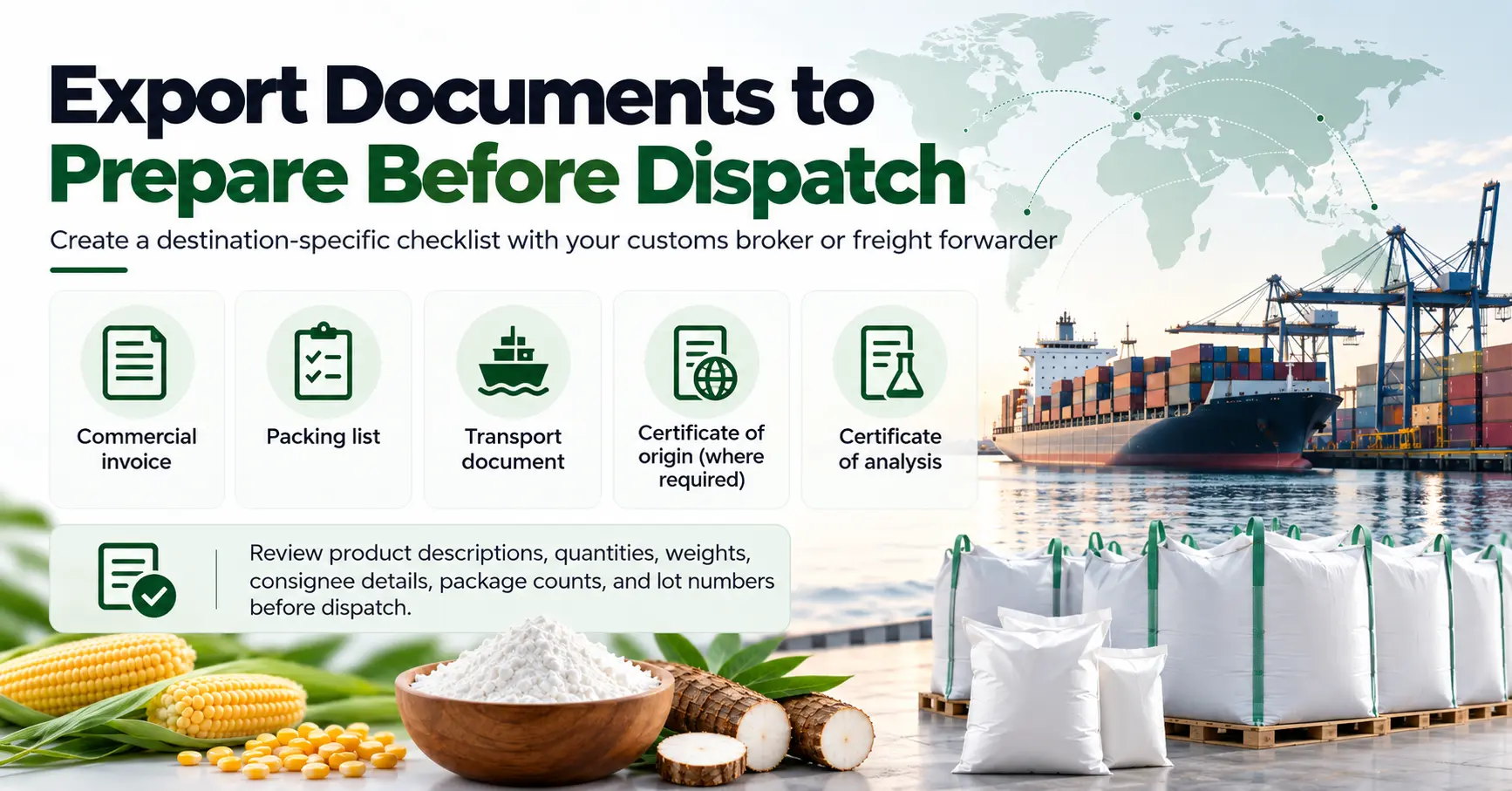
Create a destination-specific document checklist with your customs broker or freight forwarder. Common documents include the commercial invoice, packing list, transport document, certificate of origin where required, and batch certificate of evaluation.

Review draft documents before dispatch and check that product descriptions, quantities, weights, consignee details, package counts, and lot numbers match. Agree on packaging and handling instructions in writing, including bag construction, pallet setup, storage conditions, shelf life, stacking limits, and container needs.

Document readiness should be a shipment milestone. Confirm whether you need originals or electronic documents, when you will release them, and who will receive them.

9. How Should You Compare Price, Delivery Terms, and Supply Reliability?

Ask all shortlisted suppliers to quote the same spec, volume, packaging, destination, and delivery basis. Compare total landed cost rather than headline price, and require suppliers to state exclusions clearly.

Write the chosen Incoterms rule, named place or port, and version into the contract. Then confirm:

  • – Minimum order quantity and quotation validity.
  • – Production lead time versus estimated transit time.
  • – Payment milestones and document-release conditions.
  • – Inspection arrangements and handling of goods that do not meet spec.
  • – Notice periods for changes to the manufacturing site, formula, or specification.
  • – Backup plans and notice timing for supply interruptions.

Also ask whether the proposed schedule depends on existing stock or future production. This distinction can greatly change delivery risk.

10. When Are You Ready to Place the First Order?

Proceed when technical approval, supplier review, import steps, and commercial terms are documented. Treat the first shipment as a controlled review step, not an automatic repeat order.

Use this first-order approval checklist:

  • – Product approved: written specification and application-trial results accepted.
  • – Supplier verified: manufacturing site identified and relevant evidence checked.
  • – Compliance assigned: destination needs reviewed and responsible parties named.
  • – Shipment prepared: packaging, documents, delivery basis, and schedule agreed.
  • – Problems expected: sampling, rejection, complaint, and corrective-action procedures documented.

After receipt, review incoming-test results, document accuracy, delivery performance, and production outcomes before you raise order volume.

Why Work with SCG International for Industrial Starch Sourcing?

SCG International sources corn and tapioca starch, including native and modified grades for food and industrial use, from trusted factories across Thailand and Asia. Its industrial supply offer combines local sourcing networks, quality inspection, market insight, demand forecasting, logistics coordination, and end-to-end supply chain management.

For global manufacturers, this creates value beyond the product itself: one partner can help align specification, supplier review, quality documents, shipment prep, delivery planning, and supply continuity.

Talk to an Industrial Starch Sourcing Specialist

Looking for a reliable industrial starch supplier? Share your application, required function, current spec, annual volume, destination, packaging preference, and target delivery schedule with SCG International. The team can help find a good corn, tapioca, native, or modified starch option. They will also manage the supply chain from source to destination.

CONTACT SCG INTERNATIONAL

Frequently Asked Questions About OEM Procurement (FAQs)

An industrial starch supplier provides starch grades for manufacturing uses and supports technical choice, quality documents, commercial terms, and delivery. Depending on the business model, the supplier may be a maker, distributor, or sourcing and supply chain partner.

Native starch keeps its natural traits, while modified starch is processed to deliver target functions such as better stability, adhesion, film formation, or cold-water function. The right choice depends on the process and needed performance.

No. Tapioca names the botanical source. Modified describes how the starch has been processed to change function. Tapioca starch can be native or modified.

The exact set depends on destination and use, but it commonly includes a commercial invoice, packing list, transport document, certificate of origin when required, and certificate verifying the quality linked to the shipped lots.

A practical start is to test representative samples from at least two production batches, followed by application trials. Expand sampling when technical, safety, or supply risk warrants it.

Related Posts

Grid of glasses filled with blue plastic polypropylene granules, masterbatch polymer grain, with shallow DOF. HDPE or PVC resin pellets. 3d render illustration

Plastic Resin Sourcing Guide: What Industrial Buyers Should Check Before Choosing a Supplier

Plastic resin sourcing is not just a search for a matching material code. Industrial buyers need to decide if a supplier can meet the required quality, provide the right documents, deliver on time, agree on terms, and ensure a steady supply without risking production. If you already know the resin family, grade, or specification you need, the next step is to qualify the supplier behind the offer.


AKUBIG SDN. BHD. receives the SCG International Top Dealer Award 2025 in Malaysia

AKUBIG and SCG International: Celebrating a Trusted Partnership in Malaysia

Strong business partnerships are built over time — through trust, collaboration, and a shared commitment to creating value.
At the SCG INTERNATIONAL TOP DEALER AWARD 2025, held from 7–9 August 2026 in Bangkok, Thailand, SCG celebrated the achievements of its international dealer partners and recognized the strong relationships that continue to drive mutual growth across global markets.
Among the recognized partners was AKUBIG SDN. BHD. from Malaysia, represented by Mr. Lam Kian Guan, Managing Director. The recognition marks an important milestone in the long-standing partnership between AKUBIG and SCG, reflecting years of trust, collaboration, and a shared commitment to delivering value.

I’m Here To Assist You

Contact us today

Please read Terms and Conditions, Privacy Notice, Cookies Notice, and I
I acknowledge that I can withdraw the given consent at any time, and I have understood the terms and conditions and how my personal data is processed.