Search

The 7-Step OEM Sourcing Process For B2B Manufacturers

Share this post :

Facebook
LinkedIn
Business partners reviewing logistics and inventory for OEM sourcing

Key takeaways

OEM procurement involves sourcing components

sub-assemblies, or finished goods directly from the original equipment manufacturer to buyer-controlled specifications, rather than through distributors or generic suppliers.

A structured OEM sourcing process aligns engineering

procurement, and operations around cost, quality, and risk from the specification stage through supplier relationship management.

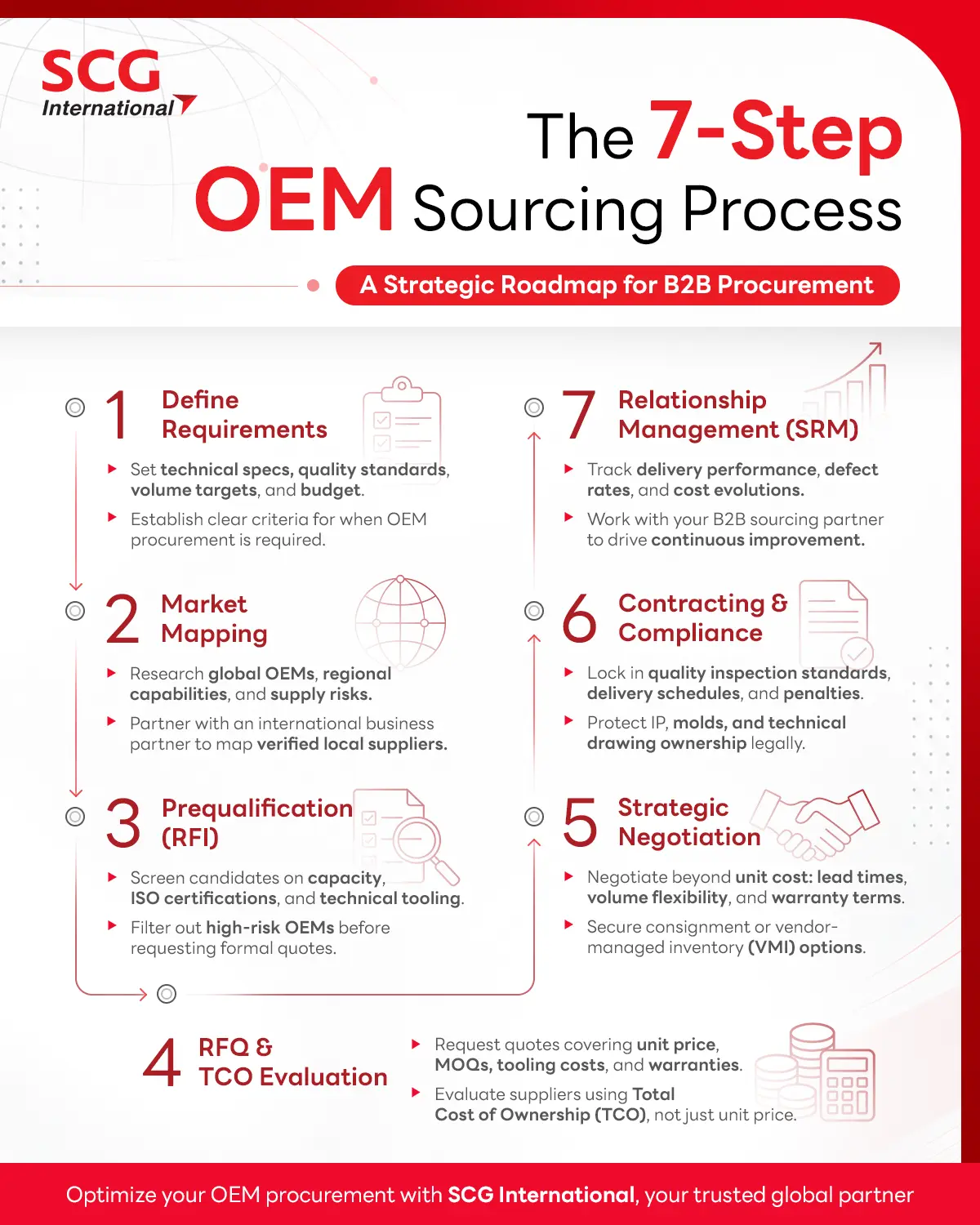
The 7-step process covers requirement definition, market mapping

prequalification, RFQ evaluation, negotiation, contracting, and ongoing supplier management.

Total cost of ownership (TCO) analysis, rather than unit price comparison

is the foundation for effective OEM supplier selection.

Working with a B2B sourcing partner like SCG International

gives manufacturers access to verified OEM networks, on-ground quality control, and cross-border logistics coordination.

Table of Contents

When component compatibility, safety, and reliability are paramount for manufacturers, opting for generic sourcing can lead to hidden expenses that eclipse a cheaper unit cost. OEM procurement addresses this by structuring how companies source parts and finished goods directly from the original equipment manufacturer, to specifications the buyer owns or controls. 

The challenge is that many procurement teams treat OEM sourcing as transactional purchasing rather than a cross-functional discipline that connects engineering, procurement, and operations. The global procurement outsourcing market reached $7.57 billion in 2025, growing at a 12.8% CAGR, reflecting how organizations across manufacturing, healthcare, and industrial sectors are investing in structured procurement capabilities. 

This guide covers what is the OEM procurement strategy, why it matters, the 7-step process, and how a B2B sourcing partner supports execution across borders.

What Is The OEM Procurement Strategy ?

OEM procurement is the practice of sourcing goods directly from the manufacturer that produces them, typically to specifications owned or controlled by the buyer. This is distinct from purchasing through distributors or sourcing generic alternatives, because OEM sourcing provides authenticity, component compatibility, full traceability, and access to technical support from the original manufacturer.

Industries with high failure costs, such as automotive, industrial machinery, electronics, healthcare equipment, construction, and agricultural machinery, frequently use this approach. Using parts not from the original equipment manufacturer in these areas can jeopardize safety, nullify warranties, and lead to regulatory issues.

Why OEM Procurement Matters For Manufacturers ?

Sourcing directly from an OEM provides several measurable advantages for B2B manufacturers:

– Quality and consistency: The original manufacturer’s process controls ensure that every batch meets the same standards, reducing defect rates and rework.

– Technical support and engineering access: OEM relationships provide direct access to engineering changes, design support, and after-sales service that distributors and generic suppliers cannot offer.

– Lower total cost of ownership: Even when the unit price is higher, OEM parts typically deliver lower costs across the product lifecycle by reducing maintenance, downtime, and warranty claims.

– Regulatory and warranty alignment: For regulated or safety-critical products, OEM sourcing ensures compliance with industry standards and preserves warranty coverage.

Core Elements Of An OEM Procurement Strategy

A well-structured strategy aligns cross-functional teams around cost, quality, and risk rather than treating OEM sourcing as a series of one-off purchases.

Aligning Procurement With Engineering And Operations

Bringing procurement into the product design and specification stages prevents late-stage redesigns, sourcing bottlenecks, and specification drift. Cross-functional agreement on specs, quality standards, certifications, and target cost at the outset keeps the OEM sourcing process on track from day one.

Balancing Cost, Quality, And Risk Through TCO

Shifting from a unit price focus to total cost of ownership (TCO) changes how procurement teams evaluate OEM suppliers. TCO factors in maintenance costs, downtime, warranty claims, defect rates, and lifecycle costs. A slightly higher OEM unit price often delivers a lower total cost than a low-price alternative when these downstream costs are included.

Risk Mitigation And Supplier Dependency

Common risks in OEM procurement include single-source dependency, longer lead times, higher upfront costs, and IP exposure. Strategic levers to manage these include multi-sourcing where feasible, maintaining safety stock, qualifying alternate OEMs, and building robust contract terms that address supply interruption scenarios.

Contracts, IP, And Quality Frameworks

Clear ownership of drawings, tooling, and technical data should be defined at the contract stage. Specifications, quality criteria, service levels, penalties, and warranties need to be embedded in the agreement. IP clauses should protect both parties while preserving the buyer’s future sourcing flexibility.

The 7 Steps Of The Procurement Process

Step 1 – Define Sourcing Methodology And Requirements

Translate business needs into OEM-ready specifications, covering technical requirements, quality standards, certifications, volumes, lifecycle expectations, and target cost. This step also clarifies when OEM sourcing is required versus when alternate suppliers are acceptable.

Step 2 – Market Research And OEM Landscape Mapping

Analyze where components are produced, which OEMs have the required capabilities, typical lead times, and supply risks. Develop a candidate pool by leveraging supplier databases, attending trade shows, and consulting with on-ground sourcing experts. This is often where a B2B sourcing partner with local market access adds the most value.

Step 3 – Prequalification Via RFI And Capability Assessment

Screen OEMs on capacity, certifications, quality systems, tooling, and experience with similar parts. The aim is to identify and remove unsuitable candidates at the outset, decreasing future technical and commercial risks before dedicating resources to elaborate quotations.

Step 4 – RFQ, TCO Evaluation, And Supplier Selection

Invite shortlisted OEMs to quote on pricing, lead times, tooling costs, warranty terms, and minimum order quantities. Evaluate offers using TCO rather than unit price alone, then select a primary OEM or a dual-sourcing model depending on risk tolerance and category strategy.

Step 5 – Negotiation Beyond Price

Effective negotiation in the OEM sourcing process goes well beyond unit cost. Negotiate lead time guarantees, volume flexibility, spare parts availability, warranty terms, escalation procedures, and consignment or vendor-managed inventory (VMI) options. Prioritizing enhanced service and lower operational risk over minor price changes can lead to more favorable results throughout the contract’s duration.

Step 6 – Contracting, Quality, And Compliance

Formalize specifications, quality and inspection criteria, delivery schedules, non-performance penalties, IP clauses, and compliance requirements. Locking in expectations at this stage prevents quality drift and disputes over the product lifecycle.

Step 7 – Supplier Relationship Management And Continuous Improvement

Monitor performance metrics, conduct regular reviews, share forecasts, and involve OEMs in design changes or new product development. Treating key OEMs as strategic partners rather than transactional vendors drives innovation and builds resilience into the supply chain.
OEM Procurement Vs Traditional Sourcing And Distributor Models

When To Choose OEM Procurement ?

OEM sourcing is the appropriate model for regulated industries, safety-critical components, applications with a high cost of downtime, and parts that require complex integration with existing systems. Authenticity, traceability, and direct manufacturer support are crucial in these situations.

When Alternatives May Be Acceptable ?

Non-critical consumables and parts with mature second-source markets may not require OEM sourcing. However, any deviation from OEM supply should go through a formal qualification process, risk assessment, and compliance review before approval.

How A Global Sourcing Partner Supports OEM Procurement ?

 End-To-End Sourcing And Supplier Verification

A sourcing partner handles OEM market research, manufacturer identification, on-site capability assessments, and quality verification before onboarding. This directly supports Steps 2 through 4 of the OEM sourcing process, accelerating candidate evaluation while reducing the buyer’s internal resource burden.


Quality, Compliance, And Logistics Management

Managing certifications, testing, documentation, and cross-border logistics from factory to destination is where many procurement teams face operational bottlenecks. A sourcing partner handles customs, tracks shipments, and resolves quality issues locally to ensure programs stay on track.


Scaling OEM Solutions And Ensuring Supply Consistency

Long-term manufacturing relationships and multi-country sourcing networks secure production capacity and diversify supply risk. This is particularly important for buyers managing volume ramp-ups, new market entry, or continuity for critical OEM programs.

How SCG International Supports OEM Procurement ?

The capabilities outlined in this guide as essential for a structured OEM sourcing process, such as on-ground supplier verification, quality inspection, multi-market compliance, and end-to-end logistics, are the same capabilities SCG International delivers. Established in 1978 as a subsidiary of SCG (Siam Cement Group), SCG International brings over 45 years of procurement and supply chain experience to OEM and industrial sourcing. The company serves over 2,000 corporate clients across more than 50 countries, with offices in 19 countries and on-ground teams across Asia, the Middle East, Africa, and Oceania.

SCG International’s OEM services cover supplier identification, capability assessment, quality inspection, documentation, and cross-border logistics. The product range features cement and construction supplies, home and lifestyle items, bathroom and kitchen fittings, decorative finishes, SPC flooring, and agricultural parts and machinery. 

With long-term manufacturing partnerships that support stable production and consistent supply, SCG International is positioned as both an international business partner and a B2B sourcing partner for manufacturers and brand owners seeking to develop private-label or custom products through verified OEM manufacturers.

Best Practices To Optimize OEM Procurement

– Involve procurement early in product design: Early involvement keeps specifications realistic and prevents overly restrictive requirements that limit the OEM candidate pool.

– Use data and digital tools for performance tracking: Monitor delivery reliability, defect rates, lead times, and cost evolution to make informed decisions at each review cycle.

– Build long-term strategic relationships: Framework agreements, forecast sharing, and early supplier involvement create mutual value and improve supply chain stability.

– Review single-source dependencies continuously: Regularly assess TCO, specifications, and supplier concentration to identify optimization opportunities and mitigate risk.


A structured
OEM sourcing process aligns cross-functional teams, brings discipline to supplier selection, and builds long-term relationships that deliver quality, resilience, and competitive advantage. The right strategy, combined with a capable sourcing partner, turns OEM procurement from a cost center into a strategic function that protects margins and supports growth.

Explore how SCG International can support your OEM sourcing and global procurement needs. SCG International offers B2B manufacturers assured sourcing through its network of verified manufacturing partners, on-site quality teams, and comprehensive supply chain management.

Learn more about SCG International’s OEM and global sourcing services and see how an experienced international business partner can strengthen your procurement operations.

References:

– Procurement Outsourcing Market Size and Share, Growth Trends 2033. Retrieved July 21, 2026, from
https://www.skyquestt.com/report/procurement-outsourcing-market

– Global Manufacturing Market 2026 Key Data, Regional Shifts, and What B2B Buyers Should Watch. Retrieved July 21, 2026, from
https://www.market-prospects.com/articles/global-manufacturing-market-2026

Frequently Asked Questions About OEM Procurement (FAQs)

For a new OEM relationship, expect 3 to 6 months from initial market mapping to first shipment. Complex components requiring tooling development, sample approvals, and certification can extend this to 9 to 12 months.

MOQs vary significantly by product category and manufacturer. Industrial components may start at  1,000 units, while construction materials or finished goods may require full container loads. Discuss MOQ flexibility during the RFQ stage to get the right information.

Include clear IP ownership clauses, non-disclosure agreements (NDAs), and tooling ownership terms in the contract before sharing any technical drawings. Retain ownership of molds and tooling wherever possible, and consider splitting production across multiple OEMs for highly sensitive designs.

Most OEMs are open to a pilot or trial order to establish quality benchmarks and build confidence on both sides. Use the trial to validate product quality, packaging, lead times, and communication responsiveness before scaling up.

The 7 steps are requirement definition, market research and OEM mapping, prequalification via RFI, RFQ and TCO evaluation, negotiation, contracting and compliance, and supplier relationship management. Each step builds on the previous one to reduce risk and improve supplier alignment.

Related Posts

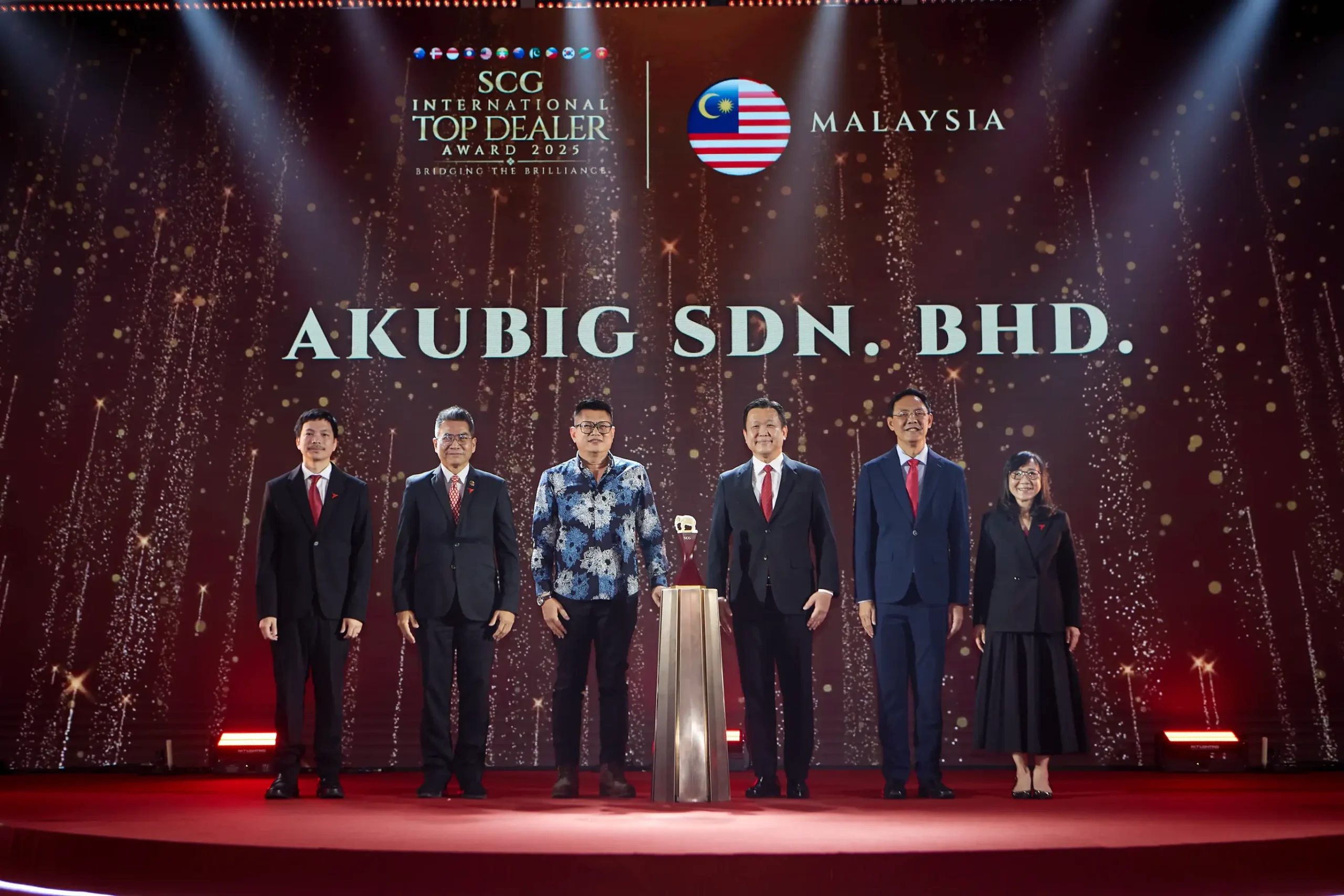
AKUBIG SDN. BHD. receives the SCG International Top Dealer Award 2025 in Malaysia

AKUBIG and SCG International: Celebrating a Trusted Partnership in Malaysia

Strong business partnerships are built over time — through trust, collaboration, and a shared commitment to creating value.
At the SCG INTERNATIONAL TOP DEALER AWARD 2025, held from 7–9 August 2026 in Bangkok, Thailand, SCG celebrated the achievements of its international dealer partners and recognized the strong relationships that continue to drive mutual growth across global markets.
Among the recognized partners was AKUBIG SDN. BHD. from Malaysia, represented by Mr. Lam Kian Guan, Managing Director. The recognition marks an important milestone in the long-standing partnership between AKUBIG and SCG, reflecting years of trust, collaboration, and a shared commitment to delivering value.

An asian supplier helping check a Thai food manufacturing quality inspection checklist

A Buyer’s Guide To Thailand’s Food Manufacturing Sector

Thailand’s food export sector generated $43.5 billion in 2025, placing the country among the world’s most productive food sourcing origins. Thailand’s food manufacturing sector exports large quantities of rice, processed chicken, canned tuna, coconut products, tropical fruits, sauces, and ready-to-eat meals, all adhering to internationally recognized safety standards.

For international buyers across retail, distribution, and food service, the opportunity is clear. The real question for procurement teams is how to move from knowing Thailand is a strong sourcing origin to identifying the right top Thai food exporter that aligns with specific category, volume, and compliance needs. 

This guide maps the exporter landscape, walks through the supplier evaluation process, and explains how a trusted food supply partner can make the process of finding a Thailand food supplier faster and more reliable.

Industrial biomass fuel supply continuity with palletized wood pellets, multiple supply routes, delivery trucks, and a worker monitoring logistics at a biomass processing facility.

When One Biomass Source Runs Short: How Industrial Buyers Protect Fuel Supply Continuity

Industrial operators moving to greener fuel are increasingly turning to biomass boiler fuel for lower net carbon emissions, more predictable costs, and long-term ESG alignment. Choosing the right fuel is not a simple swap. It depends on boiler design, local supply availability, moisture and ash tolerance, and the consistency of fuel specifications from shipment to shipment.

I’m Here To Assist You

Contact us today

Please read Terms and Conditions, Privacy Notice, Cookies Notice, and I
I acknowledge that I can withdraw the given consent at any time, and I have understood the terms and conditions and how my personal data is processed.