Key takeaways
Organic coconut water from Thailand can give Saudi supermarkets and GCC distributors another option within imported, natural, and ready-to-drink beverage ranges. This guide is designed for retail buyers, importers, category managers, and foodservice teams planning a natural coconut drink retail Saudi Arabia programme or evaluating supply for other GCC markets.
The commercial decision should not be based on taste or packaging alone. Buyers should also review product specifications, supporting documentation, market requirements, order quantities, logistics, and the supplier’s ability to support repeat orders. Product claims and market eligibility should always be confirmed for the selected SKU and destination before purchase.
Is This Product Right for Your Market?
The category may be relevant if your business needs a shelf-ready or distribution-ready coconut water brand for supermarket KSA channels, convenience retail, speciality stores, cafés, hotels, gyms, online grocery, or foodservice. The final fit will depend on the selected product, target customer, price position, packaging, and local demand.
For Saudi and GCC markets, a practical sourcing plan should cover three basics: consistent product specifications, appropriate documentation, and packaging that fits the intended channel. A supermarket may need consumer packs that are easy to merchandise. A distributor may need palletised supply, export documents, and a repeat-order plan. A hospitality buyer may focus on serving format, storage, and availability during planned demand periods.
If you are comparing an organic coconut water supplier Saudi Arabia buyers can work with, consider the complete commercial offer. Depending on the selected product and supporting documents, the route may involve an imported brand, private label, or a wider Thai coconut range with relevant certification options.
Product Positioning for Saudi and GCC Retail
Coconut water and coconut milk should be treated as separate product categories. Coconut water is generally positioned as a ready-to-drink beverage. Coconut milk is commonly positioned for cooking, cafés, food manufacturing, and foodservice. Buyers should use the product specification and ingredient declaration to confirm the exact composition and intended use of every SKU.
For retail planning, a 100% coconut water import Middle East programme may be placed within beverage ranges near juices, hydration products, natural drinks, or premium imported beverages. A coconut milk supplier KSA halal programme may serve pantry, culinary, café, or foodservice needs. The right placement depends on the product, applicable claims, pack format, retailer strategy, and local category structure.
The product story should remain clear and supportable. Possible communication points include Thai origin, coconut water content, pack format, and relevant certification where valid documentation is available. Avoid using organic, halal, 100%, health, or nutrition claims unless the selected product and destination requirements support them.
Key Product Features to Review
Strong sourcing decisions are built on clear, consistent information. Buyers should be able to understand what the product is, how it is packed, what documents are available, and how it will be supplied.
– Thai origin: Confirm the country-of-origin information for the selected product and ensure that packaging and documents are consistent.
– Organic positioning: Use this claim only when valid certification applies to the selected SKU and target market.
– Product composition: Review whether the product is 100% coconut water, made from concentrate, or includes other declared ingredients.
– Pack options: Confirm the available carton, bottle, or consumer-pack formats directly with the supplier.
– Export documentation: Request specifications, ingredient details, shelf-life information, storage conditions, and shipment documents before ordering.
– Halal documentation: Confirm whether halal documentation is available and whether it is applicable to the product, manufacturing site, and target market.
– Private label potential: Confirm minimum order quantity, artwork process, packaging availability, certification, and production terms before presenting an own-brand option.
These checks help procurement and category teams plan the listing, internal review, logistics, and reorder process with fewer assumptions.
Benefits That Matter to Buyers
For supermarkets, coconut water may add another option to imported, natural, or ready-to-drink beverage ranges. The commercial value will depend on product-market fit, retail price, margin expectations, shelf placement, availability, and customer response.
For distributors, the category may offer access to several channels, including supermarkets, speciality grocery, cafés, hotels, corporate supply, foodservice, and online retail. Each channel may require a different pack size, case configuration, price point, or sales approach.
For hospitality and foodservice teams, coconut water may be considered as a packaged beverage or menu ingredient, subject to the product specification, storage instructions, and intended use. Buyers should avoid making consumer benefit claims that are not substantiated by approved product information.
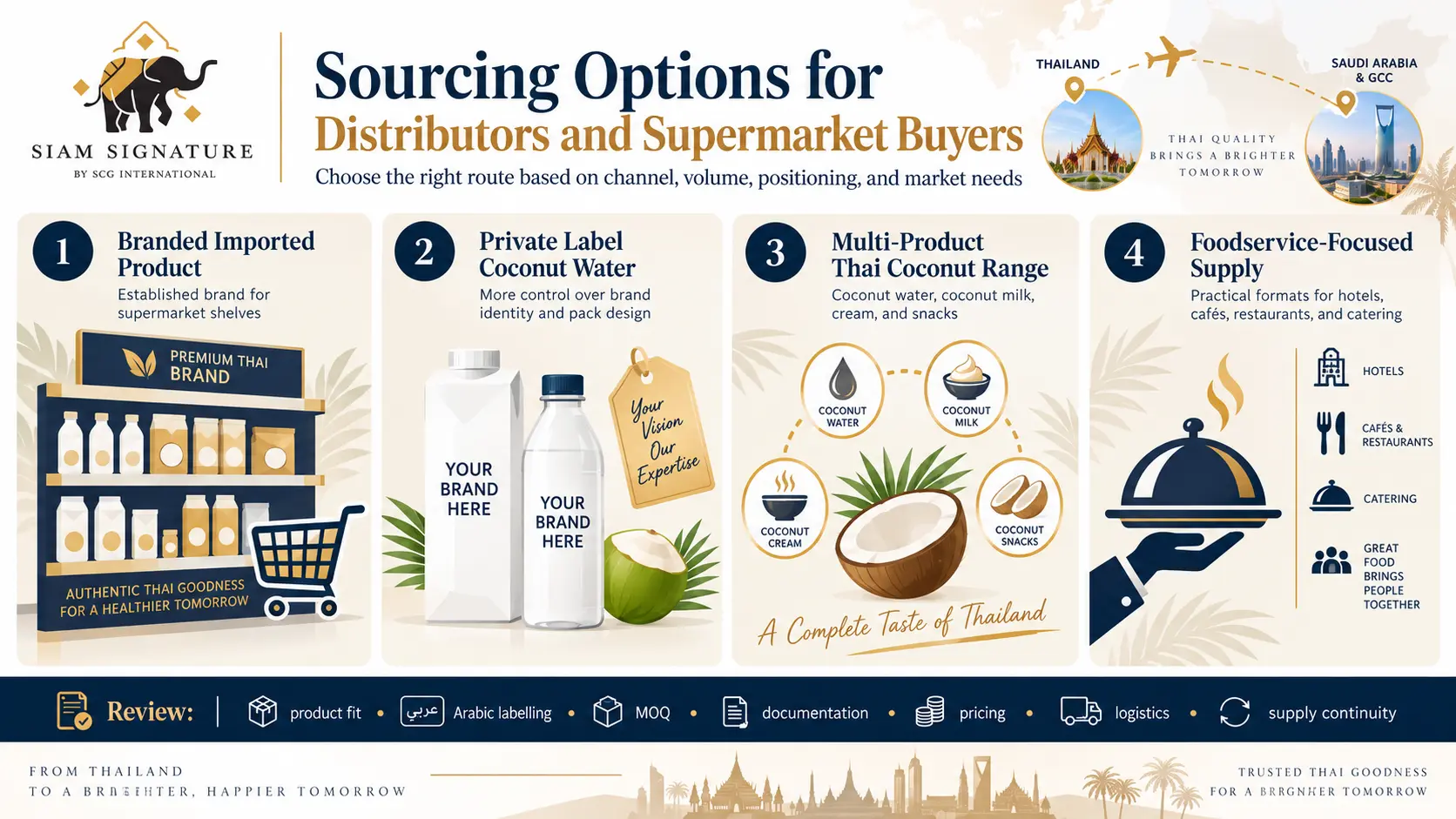
Sourcing Options for Distributors and Supermarket Buyers
A practical import plan should start with the channel and business model, not only the pack. Before requesting a quotation, define where the product will sell, expected order volume, target price position, and the level of brand or launch support required.
Branded Imported Product
This route may suit buyers seeking an established coconut water brand for supermarket KSA shelves. It can reduce brand-development work, but buyers should still review product specifications, Arabic labelling needs, supporting documents, authorised supply status, and market
Private Label Coconut Water
Private label may suit supermarket groups and GCC distributors that want more control over brand identity, pack design, and commercial positioning. It also requires clear agreement on minimum order quantity, product selection, artwork, approval, documentation, production schedule, and launch timing.
Multi-Product Thai Coconut Range
A distributor may evaluate coconut water together with coconut milk, coconut cream, snacks, or other Thai coconut products export halal certified where valid product-level documentation is available. Each SKU should be reviewed separately. Certification or market suitability for one product should not be assumed to apply to another.
Foodservice-Focused Supply
Hotels, cafés, restaurants, and catering businesses may prioritise practical pack sizes, storage, handling, and replenishment. When coconut water is used as an ingredient, buyers should confirm that the selected product is suitable for the intended application.
If Saudi buyers are evaluating a Thaicoco coconut water distributor Saudi sourcing option, the same checks should apply: authorised supply status, product fit, specification, documentation, pack format, pricing terms, logistics, and continuity of supply.
Packaging, Shelf Presence, and Merchandising
Packaging protects the product and communicates its purpose. A single-serve pack may suit grab-and-go locations, while larger formats or multipacks may fit other retail or foodservice needs. Buyers should select the format according to the intended channel, storage conditions, shelf space, target price, and expected rate of sale.
For Saudi supermarkets, labelling and artwork should be reviewed for the selected product and current market requirements before production or shipment. Where Arabic information, organic claims, halal marks, or 100% coconut water claims are used, the final artwork and supporting documents should be checked by the importer and qualified compliance specialists.
A practical packaging review may include:
– Clear product name and country-of-origin information
– Ingredient and nutrition information that matches the approved specification
– Pack size, storage information, production and expiry details
– Organic or halal claims only where supported by applicable documents
– Barcode, case markings, and warehouse-handling requirements
– Arabic label or translation review where required
– Product images and artwork for listing, sales, and e-commerce review
Final packaging decisions should be based on current requirements and the importer’s approval. Do not rely on the appearance of a sample pack as evidence that every claim is approved for the target market.
Documentation and Compliance Planning
Import rules and documentation requirements can vary by product, claim, destination, and shipment. Buyers should request and review documents before confirming production. The importer and qualified regulatory specialists should determine the exact requirements that apply at the time of import.
A practical document request may include:
– Product specification sheet
– Ingredient declaration and nutrition information
– Shelf life and storage conditions
– Country-of-origin information
– Organic certificate, when an organic claim is proposed
– Halal certificate, when required for the product or channel
– Commercial invoice and packing list
– Certificate of origin, where applicable
– Product images, label files, and artwork for review
– Other product or shipment documents requested by the importer or relevant authority
No buyer should assume that a claim is usable simply because it appears on a sample, website, or catalogue. Product claims, certificates, labels, and shipment documents should be checked together for the selected SKU and destination.
Taste Review and Commercial Use Cases
Taste and product suitability should be assessed through sample review. A buying team may compare aroma, sweetness, aftertaste, appearance, pack convenience, and overall fit with its target customer. These are evaluation criteria, not guaranteed product characteristics.
Possible commercial use cases, subject to the selected product and local market plan, include:
– Supermarkets: single units, multipacks, imported beverage ranges, or promotional activity
– Convenience stores: chilled or grab-and-go placement
– Hotels and resorts: packaged beverage service or approved menu applications
– Cafés and juice bars: smoothies, mocktails, or other menu uses where the product is suitable
– Foodservice: formats selected for handling, storage, and operational requirements
– Online grocery: individual units, bundles, or category listings
The strongest retail message is a clear and accurate description of the product, supported by consistent packaging and documentation.
Pricing, Quotation, and Order Planning
Pricing may be affected by product format, certification requirements, order volume, packaging, branding model, shipment terms, and destination. A branded product, private label programme, trial order, and larger-volume plan may have different commercial structures.
To request a relevant quotation, buyers should share:
– Target country, port, or agreed delivery point
– Preferred pack size and packaging type
– Branded product or private label requirement
– Estimated first order and expected repeat demand
– Organic and halal documentation requirements
– Arabic label or artwork requirements
– Intended sales channel
– Requested shipment timing and commercial terms
– Benchmark product or target retail price, if available
This information helps the buyer and supplier assess product fit, landed-cost considerations, channel suitability, and operational requirements before committing to a launch.
Built for Saudi Supermarkets and GCC Distribution
A natural coconut drink retail Saudi Arabia programme should be designed around the selected channel. Retail buyers may focus on shelf communication, pack suitability, pricing, and replenishment. Distributors may place more emphasis on documentation, case configuration, logistics, and repeat supply. Foodservice buyers may prioritise storage, handling, and operational use.
A 100% coconut water import Middle East programme requires verified composition, consistent documentation, and a repeatable supply plan. A coconut milk supplier KSA halal range may require different pack formats and buyer documentation. Each route should be evaluated separately based on the selected products and destination requirements.
Why Source Coconut Water through Siam Signature by SCG International?
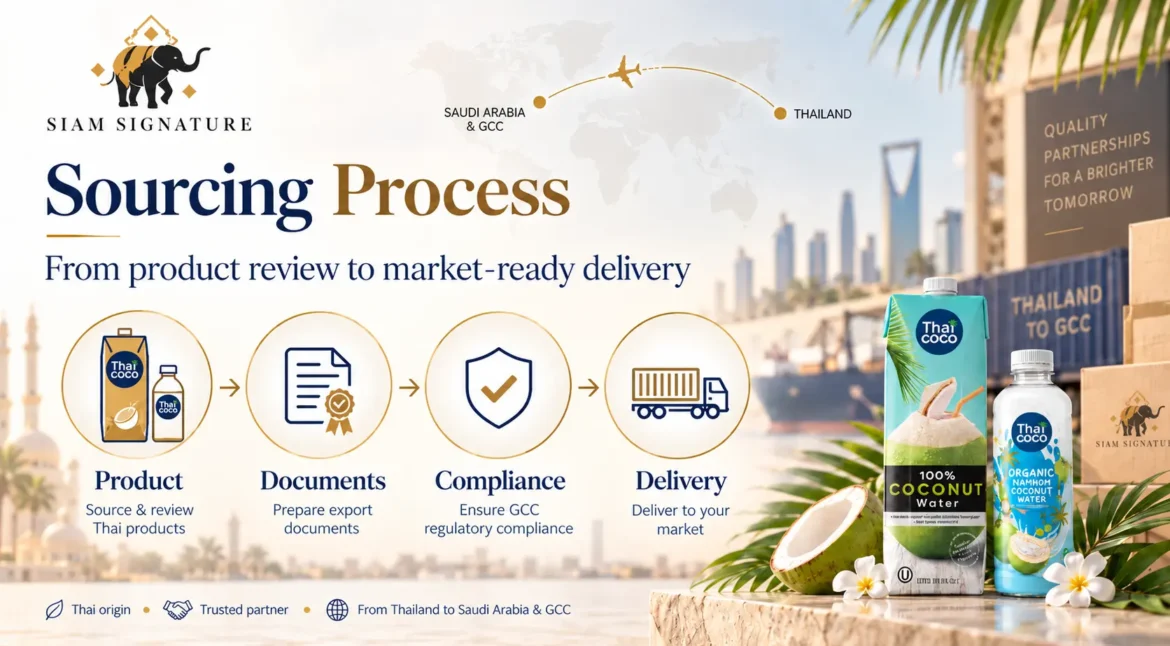
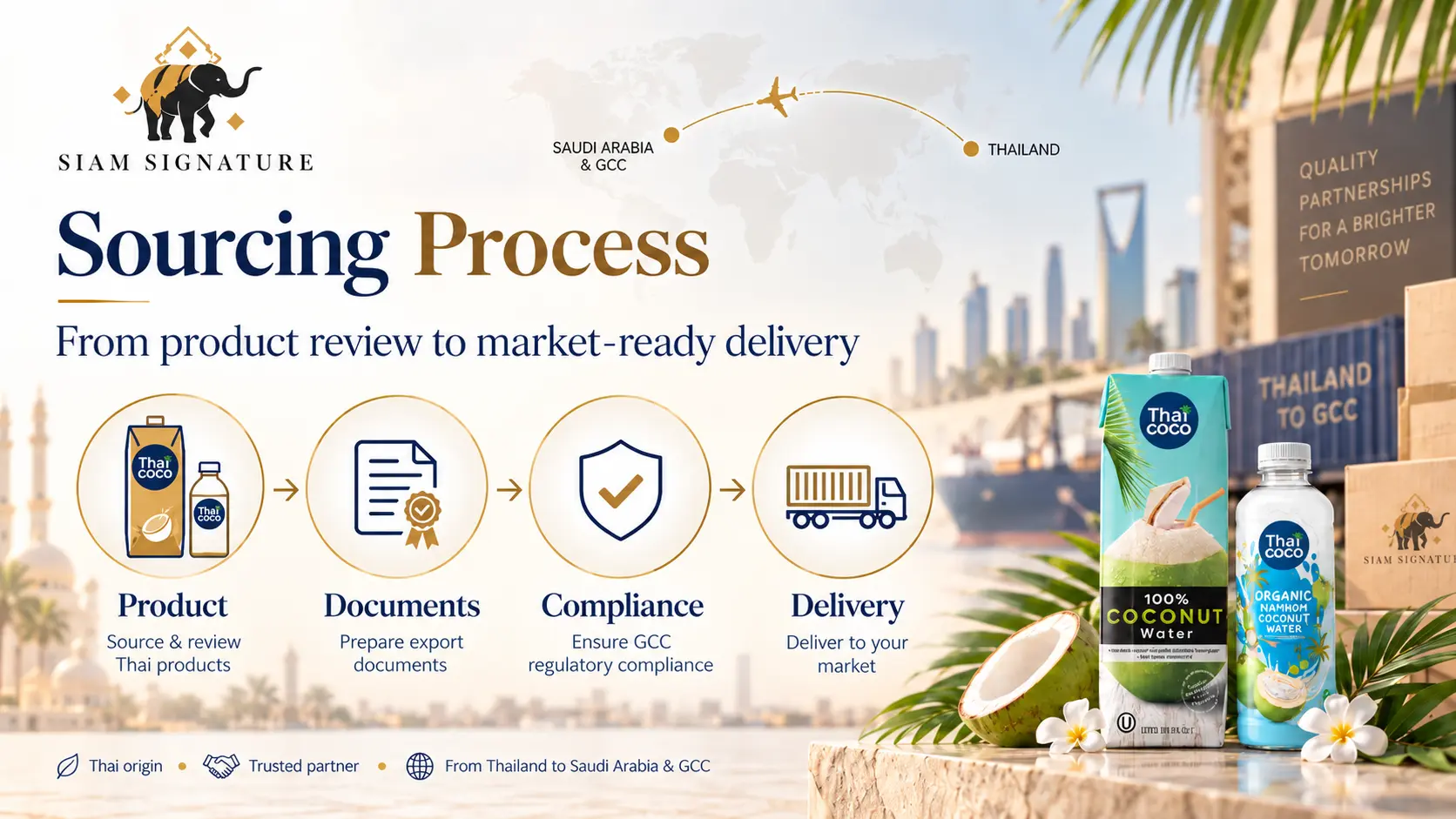
Finding the right coconut water product is only one part of a successful import programme. Buyers may also need product discovery, supplier coordination, trade discussions, documentation planning, packaging review, logistics coordination, and products that fit their target market.
Siam Signature by SCG International connects Thai food and beverage brands with international retailers, distributors, importers, and buyers. It serves as a food and beverage sourcing and distribution platform that helps simplify product discovery, supplier coordination, and cross-border trade discussions.
A Trusted Sourcing Partner
For businesses evaluating an organic coconut water supplier Saudi Arabia sourcing option, Siam Signature provides one point of coordination across product review, communication with Thai suppliers, packaging and documentation discussions, commercial terms, and export planning. Product-level specifications, certifications, availability, and destination requirements should be confirmed for every selected SKU.
Built for Retail and Distribution
Siam Signature is designed for supermarket chains, importers, distributors, e-commerce operators, foodservice businesses, and market-entry teams. The sourcing process starts with the buyer’s target market, retail format, customer needs, product categories, and commercial requirements, then matches these needs with suitable Thai food and beverage opportunities.
More Than Coconut Water
Buyers can explore coconut water alongside a wider portfolio of Thai food and beverage categories. Opportunities may include beverages, snacks, ready-to-eat products, sauces, seasonings, grocery staples, pantry products, and emerging brands, subject to product availability and destination-market requirements.
From Product Discovery to Long-Term Growth
Siam Signature focuses on practical coordination and long-term business relationships rather than one-off product introductions. The goal is to help buyers and Thai suppliers align early on product fit, packaging, documentation, supply expectations, trade terms, and future category growth.
Whether you are sourcing a coconut water brand for supermarket KSA channels, planning a 100% coconut water import Middle East programme, or evaluating broader Thai food and beverage categories, Siam Signature offers a structured path to sourcing discussions through SCG International.
How to Get Started
- Define the target market, customer, and sales channel.
- Choose branded, private label, foodservice, or multi-product sourcing.
- Confirm the required product composition, pack format, and commercial positioning.
- Request product specifications, certificates, shelf-life information, and shipment documents.
- Review samples with procurement, category, quality, and sales teams.
- Ask the importer and qualified specialists to confirm current labelling and import requirements.
- Confirm price, order quantity, lead time, commercial terms, and delivery scope.
- Complete artwork and documentation review before production.
- Prepare listing, launch, inventory, and reorder plans.
Explore Thai Food and Beverage Opportunities with Siam Signature
If your business is looking for an organic coconut water supplier Saudi Arabia buyers can work with, or if you are exploring wider Thai and Asian food sourcing opportunities, Siam Signature by SCG International can help you review suitable product options.
Share your target market, product categories, preferred packaging, estimated order volume, certification needs, and delivery destination. The Siam Signature team can support product discovery, supplier coordination, trade discussions, documentation planning, and cross-border delivery arrangements based on agreed scope and commercial terms.