Search

A Buyer’s Guide To Thailand’s Food Manufacturing Sector

Share this post :

Facebook
LinkedIn
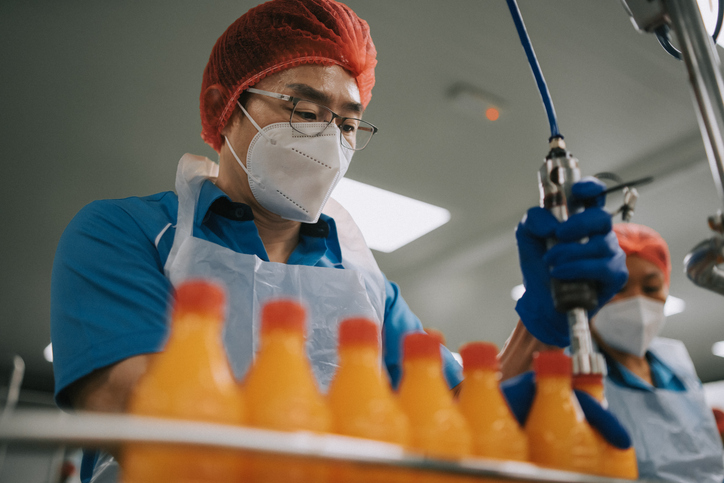
An asian supplier helping check a Thai food manufacturing quality inspection checklist

Key takeaways

Thailand's food export sector generated $43.5 billion in 2025, with strengths across rice, processed poultry, canned seafood, tropical fruits, sauces, snacks, and beverages.

A top Thai food exporter is defined by relevant certifications (GMP, HACCP, BRC, Halal), proven export history, production capacity, and transparent quality control.

Supplier types in Thailand range from large-scale food manufacturing operations with OEM and private-label capacity to specialized category exporters, trading companies, and full-service sourcing partners.

Evaluating suppliers on total landed cost, destination-market compliance, and communication practices is essential for long-term sourcing success.

Working with a trusted food supply partner like SCG International gives buyers single-point coordination across supplier verification, quality management, and cross-border logistics.

Thailand’s food export sector generated $43.5 billion in 2025, placing the country among the world’s most productive food sourcing origins. Thailand’s food manufacturing sector exports large quantities of rice, processed chicken, canned tuna, coconut products, tropical fruits, sauces, and ready-to-eat meals, all adhering to internationally recognized safety standards.

For international buyers across retail, distribution, and food service, the opportunity is clear. The real question for procurement teams is how to move from knowing Thailand is a strong sourcing origin to identifying the right top Thai food exporter that aligns with specific category, volume, and compliance needs. 

This guide maps the exporter landscape, walks through the supplier evaluation process, and explains how a trusted food supply partner can make the process of finding a Thailand food supplier faster and more reliable.

Thailand's Food Export Industry At A Glance

Thailand ranked as the 15th largest food exporter globally in 2025, with a 2.14% share of world food trade. The country’s total agricultural and related product exports reached $50.9 billion, with food manufacturing and processed goods making up a significant portion. Key export destinations include Japan, the United States, China, ASEAN neighbors, the European Union, and the Middle East.

Thailand’s export strength comes from a well-integrated ecosystem: upstream agriculture supplies consistent raw materials, mid-stream facilities process them under international certifications, and downstream logistics infrastructure connects production to global shipping routes. Product categories where Thailand leads include:

Rice

Thailand exported 7.9 million tons of rice in 2025, earning approximately $4.5 billion.

Canned and frozen seafood

Canned tuna exports reached $2.5 billion in 2024, with Thailand maintaining its position as the world's number one canned tuna exporter.

Processed chicken

Thailand is one of the world's top poultry exporters, with HACCP and Halal-certified facilities serving Japan, the EU, and the UK.

Coconut products

Coconut milk, cream, and oil are exported globally, with Thailand as a primary origin for retail and food service buyers.

Tropical fruits, sauces, condiments, snacks, and beverages

These categories continue to grow as global demand for Asian flavors and convenience foods increases.

Types Of Top Thai Food Exporters

The term “top exporter” covers several supplier types, each suited to different buyer profiles. Understanding the differences helps procurement teams match the right supplier model to their sourcing needs.

Large-Scale OEM And Private-Label Food Manufacturers

These are full-scale factories equipped with GMP, HACCP, ISO, BRC, and Halal certifications. They serve retail chains, supermarket private-label programs, and high-volume importers who require consistent output, custom packaging, and strict compliance documentation. This model is most advantageous for buyers who can place large minimum orders and already have distribution networks in place.

Specialized Category Exporters

These exporters focus on specific categories such as rice, canned seafood, coconut products, or tropical fruits. They offer category depth and product specialization, making them a strong fit for buyers who need deep expertise in a single product vertical. Their production lines, certifications, and R&D abilities are usually fine-tuned for a single product family.

Food Trading Companies And Consolidators

Trading companies aggregate multiple brands and SKUs into mixed containers. This model is useful for smaller or diversified buyers who need product variety without managing relationships with multiple factories. Coordinators manage supplier interactions, lessening the buyer’s administrative workload.

Global Sourcing Partners Based In Thailand

Bangkok-based sourcing partners operate with on-ground teams, vetted supplier networks, and end-to-end supply chain execution. They manage supplier verification, quality control, documentation, compliance, and cross-border logistics as a single point of coordination. This model is ideal for buyers requiring supply chain transparency without needing a local Thai team.

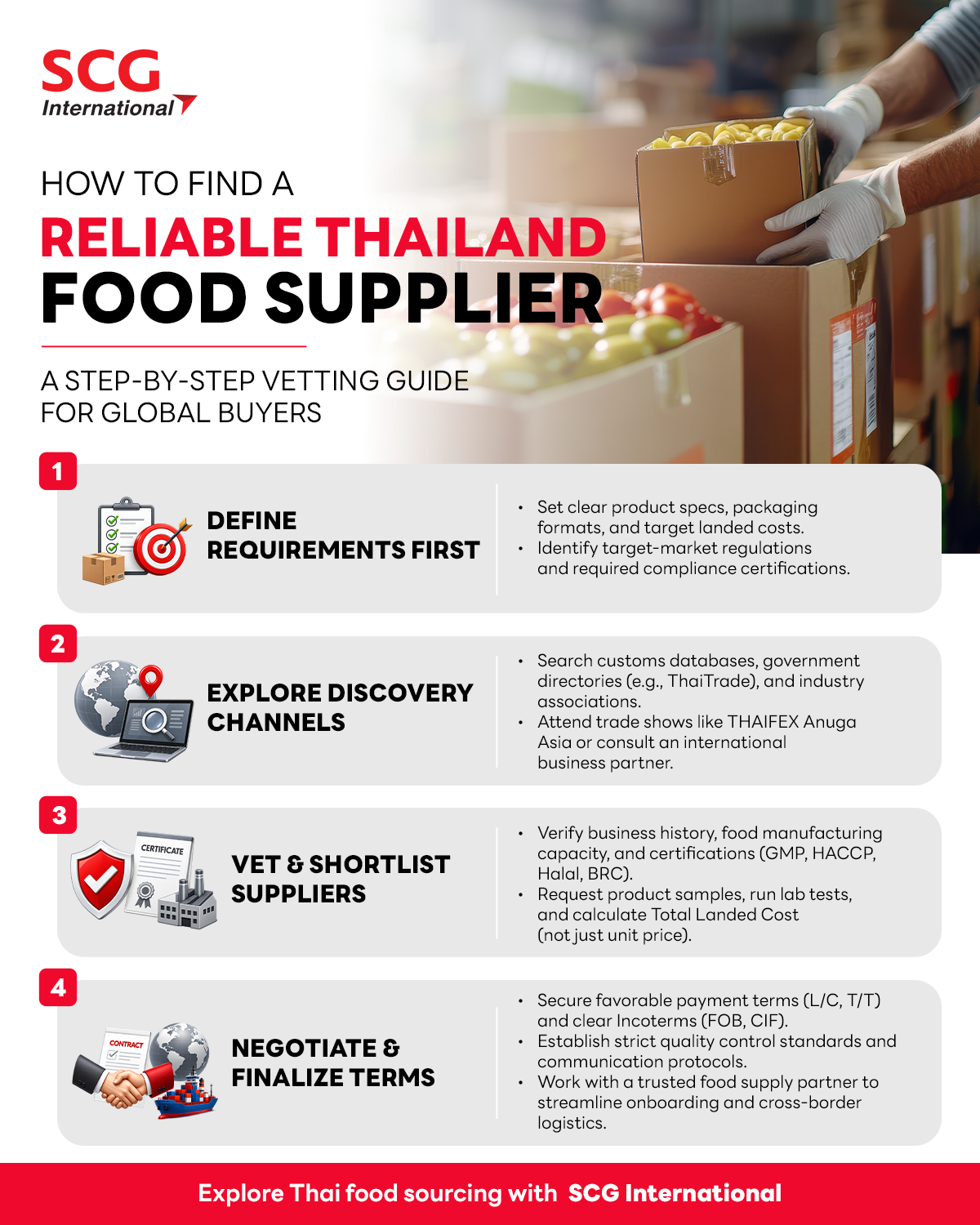
SCG International step-by-step guide on how to find and vet reliable Thailand food suppliers for global buyers

How To Find A Reliable Thailand Food Supplier

Define Product And Market Requirements First

Before reaching out to any supplier, define the product specifications, packaging format, required certifications, target landed price, volume commitments, and destination market regulations. Sharper internal specs filter out suppliers that cannot meet the brief and shorten the overall evaluation cycle. When buyers initiate contact without specifying requirements, they commonly experience delays and mismatched proposals.

Use Multiple Channels For Supplier Discovery

Relying on a single source limits visibility into the market. Effective buyers use a combination of channels:

1) Trade data and customs databases : These identify active exporters in specific product categories based on real shipment records.

2) B2B marketplaces and Thai government directories : Platforms such as ThaiTrade provide curated listings of verified Thai exporters across food categories.

3) Trade fairs : Events like THAIFEX Anuga Asia offer direct access to product sampling, factory introductions, and face-to-face meetings with exporters.

4) Industry associations : Thai chambers of commerce and food processors’ associations can provide curated supplier introductions based on category and buyer profile.

5) Local sourcing partners : On-ground partners with in-country teams and category expertise can accelerate the discovery process and pre-screen candidates.

Vet And Shortlist Supplier Candidates

Once a list of potential suppliers is assembled, the vetting process begins:

  • 1) Business verification : Confirm registration, export history, and experience shipping to the destination market.
  • 2) Certification review : Check that the supplier holds certifications relevant to the target market, such as HACCP, BRC, FDA registration, Halal, or EU standards.
  • 3) Capacity assessment : Evaluate production capacity, minimum order quantities, lead times, and the ability to scale as demand grows.
  • 4) Sample and audit process : Request product samples, run lab tests, and conduct factory audits either directly or through third-party inspection firms.
  • 5) Total landed cost analysis : Compare suppliers on total landed cost, including freight, duties, insurance, and compliance costs, rather than ex-factory or FOB price alone.

Negotiate Terms And Structure The Agreement

With a shortlisted supplier, formalize the commercial relationship. Key areas to address include pricing, payment terms (T/T, L/C), and preferred Incoterms (FOB, CIF). Written specifications should cover quality tolerances, labeling requirements, and change-control processes. To ensure stable long-term partnerships, it’s important to establish a regular communication rhythm that respects Thai business culture’s emphasis on relationships and mutual respect.

When To Work With A Global Sourcing Partner

Direct sourcing from Thailand works well for large single-category buyers with established procurement teams and in-market relationships. For other buyer profiles, working through a professional sourcing partner offers clear advantages. A sourcing partner extends the buyer’s procurement team by managing supplier sourcing, validation, quality control, and logistics.

A simple decision framework helps clarify the right approach :

Direct relationships

Best suited to large buyers focused on a single product category with high volumes and an existing network in Thailand.

Sourcing partner

Ideal for smaller procurement teams, first-time buyers in Thailand, or companies running complex multi-category programs that require coordination across several factories.

Hybrid model

Some buyers maintain direct relationships for core categories while using a sourcing partner for newer or lower-volume product lines.

How SCG International Can Support Your Business

The criteria for selecting a top Thai food exporter outlined in this guide, such as verified certifications, proven export history, production capacity, multi-market experience, and end-to-end logistics capability, are the same standards SCG International operates by. Established in 1978 as a subsidiary of SCG (Siam Cement Group), SCG International brings over 45 years of procurement and supply chain experience to international food sourcing. The company serves over 2,000 corporate clients across more than 50 countries, with offices in over 15 countries and on-ground teams spanning Asia, the Middle East, Africa, and Oceania.

Siam Signature, the food and beverage business under SCG International, connects international buyers with certified Thai and Asian food and beverage producers. Product coverage spans fresh fruits and vegetables, beverages, ready-to-eat foods, snacks, sauces, canned goods, and frozen seafood. Where typical traders handle only import and export, SCG International manages the full lifecycle, coordinating supplier verification, compliance documents, packaging, and international shipping through to market expansion in destination countries. 

We operate local offices with in-house teams in Saudi Arabia, the UAE, India, Malaysia, and other key markets giving buyers direct support on the ground rather than remote coordination from a single hub. For instance, SCG International recently coordinated a multi-category shipment of beverages and ready-to-eat meals for a Middle Eastern retail chain, consolidating supply from leading Thai
Practical Checklist For Working With Thai Food Suppliers

Pre-Sourcing Preparation Checklist

  • – Product list with detailed specifications and packaging requirements
  • – Required certifications for the destination market
  • – Target price range and volume commitments
  • Launch timeline and shipment schedule
  • – Destination country compliance and import regulations

Supplier Evaluation And Vetting Checklist

  • – Business registration and company verification
  • – Export history and destination-market experience
  • – Relevant certifications (HACCP, BRC, FDA, Halal, ISO)
  • – Product samples and lab test results
  • – Production capacity confirmation and scalability assessment
  • – Client references and responsiveness

Onboarding And First Shipment Checklist

  • – Signed contracts with agreed Incoterms and payment terms
  • – Approved artwork, labels, and packaging
  • – Shipping plan with confirmed freight and routing
  • – Pre-shipment inspection plan
  • – Contingency plans for delays or quality issues

Identifying a top Thai food exporter comes down to matching the right supplier profile to specific category, compliance, and volume requirements. Choosing the best supplier or sourcing partner safeguards profits, minimizes dangers, and aids in future global market growth.

Explore how SCG International can support your Thailand food sourcing. The Siam Signature team connects global buyers with certified Thai and Asian food manufacturing partners through end-to-end supply chain support. Learn how a single-point international business partner can simplify your procurement process. Submit your product requirements to the Siam Signature team for a free sourcing consultation – get in touch today.

Frequently Asked Questions (FAQ)​

Lead times vary by product category and order volume. Canned and shelf-stable goods typically require 45 to 90 days from confirmed order to shipment, while fresh or frozen products may take 30 to 60 days. Factor in additional time for artwork approvals, lab testing, and customs clearance at the destination port.

FOB (Free on Board) Bangkok or Laem Chabang is the most common arrangement, where the buyer manages freight and insurance from the Thai port onward. CIF (Cost, Insurance, and Freight) is also used when buyers prefer the supplier to handle shipping to the destination port. The choice depends on how much control the buyer wants over logistics costs.

Yes. Thailand has a well-established Halal certification infrastructure overseen by the Central Islamic Council of Thailand. Many food manufacturing facilities hold Halal certification alongside GMP and HACCP, which is one reason Thai food products have strong market access in the Middle East and Southeast Asia.

Start by attending THAIFEX Anuga Asia, which runs annually in Bangkok and brings together hundreds of Thai food exporters under one roof. Alternatively, engage a sourcing partner like SCG International, which handles supplier identification, vetting, and logistics on your behalf, reducing the learning curve for first-time buyers.

First orders typically require a Letter of Credit (L/C) or a deposit via Telegraphic Transfer (T/T) with the balance paid before shipment. As the relationship matures and trust is established, many suppliers offer open account terms of 30 to 60 days for repeat buyers with a strong payment history.

Related Posts

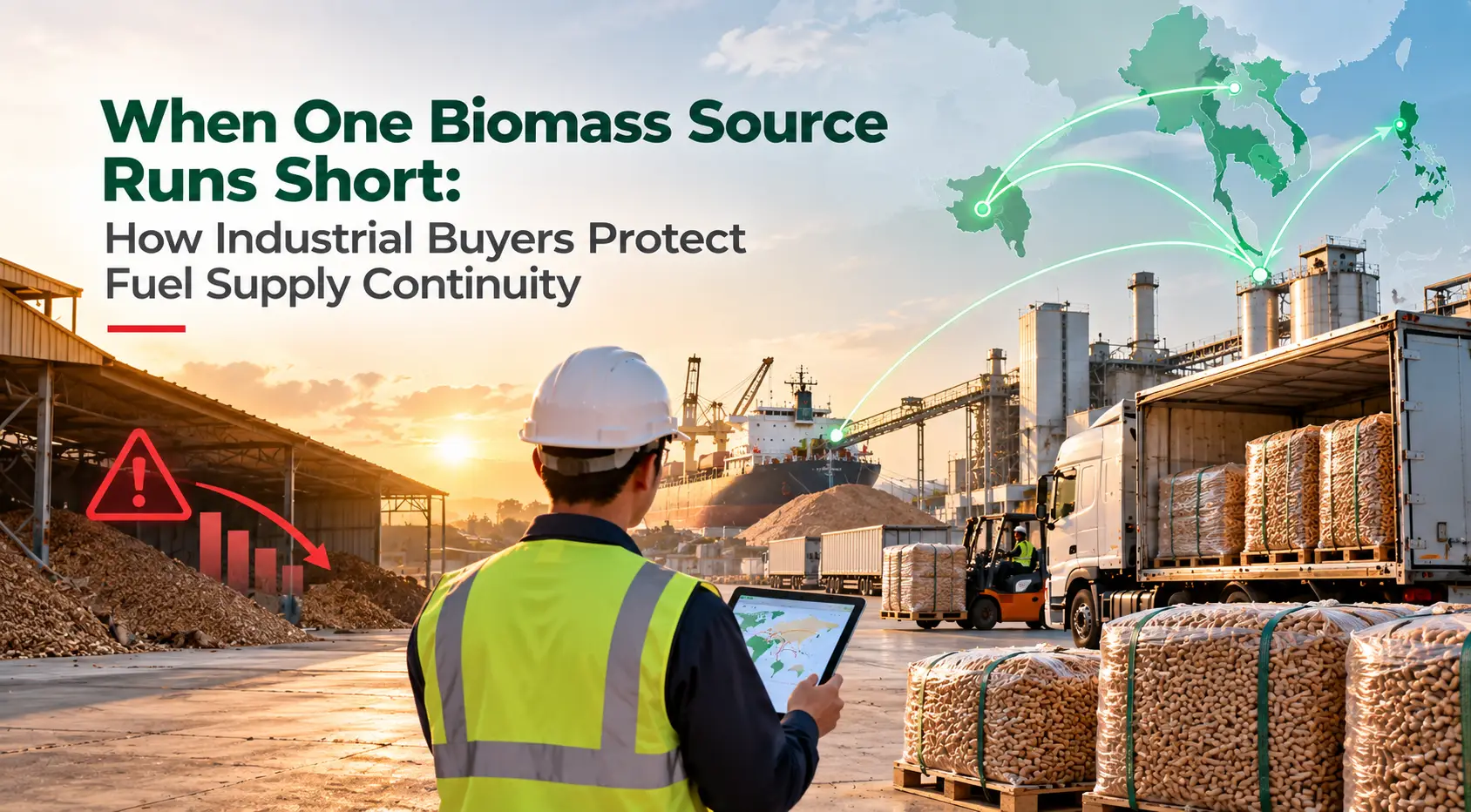
Industrial biomass fuel supply continuity with palletized wood pellets, multiple supply routes, delivery trucks, and a worker monitoring logistics at a biomass processing facility.

When One Biomass Source Runs Short: How Industrial Buyers Protect Fuel Supply Continuity

Industrial operators moving to greener fuel are increasingly turning to biomass boiler fuel for lower net carbon emissions, more predictable costs, and long-term ESG alignment. Choosing the right fuel is not a simple swap. It depends on boiler design, local supply availability, moisture and ash tolerance, and the consistency of fuel specifications from shipment to shipment.

Business partners reviewing logistics and inventory for OEM sourcing

The 7-Step OEM Sourcing Process For B2B Manufacturers

When component compatibility, safety, and reliability are paramount for manufacturers, opting for generic sourcing can lead to hidden expenses that eclipse a cheaper unit cost. OEM procurement addresses this by structuring how companies source parts and finished goods directly from the original equipment manufacturer, to specifications the buyer owns or controls.

Bulk cement discharged at a U.S. port terminal by global cement supplier SCG International

What Is EPD Cement? Why This Certification Matters for Modern Cement Buyers

EPD cement is cement whose environmental performance has been measured by life cycle assessment, documented in an Environmental Product Declaration, and verified by an independent third party under ISO 14025. An EPD does not mean the cement is “green.” It means the carbon number attached to that cement is auditable

I’m Here To Assist You

Contact us today

Please read Terms and Conditions, Privacy Notice, Cookies Notice, and I
I acknowledge that I can withdraw the given consent at any time, and I have understood the terms and conditions and how my personal data is processed.