Search

Cement Raw Material Sourcing with Advice to Reduce Costs & Carbon

Share this post :

Facebook
LinkedIn
SCG International helps businesses in cement production cost control

Key takeaways

Table of Contents

A cement raw material sourcing partner helps a plant lower both production cost and carbon by sourcing consistent raw materials and fuels and advising on how to use them. The two levers are fuel substitution, which replaces part of the kiln’s fossil fuel with alternative fuel, and clinker reduction, which swaps some clinker for lower-carbon cementitious materials without losing strength. When done well, these cut costs and emissions at once.

For cement producers, the harder part is finding a partner who understands the materials, the market, and the chemistry well enough to protect quality while making those changes. The sections below cover the common challenges, the materials involved, and how SCG International supports producers through them to further enhance business value, which is vital for organizational management.

Challenges Facing Cement Plant Operators Today

Lack of support from raw material sourcing partners in different countries Operators may encounter problems with management and local support when sourcing raw materials from abroad due to the absence of experienced and reliable raw material sourcing partners in foreign countries. They may face issues such as a lack of in-depth understanding of markets, regulations, and business cultures in destination countries and a lack of solid relationships with local raw material suppliers, making negotiating or obtaining reasonable offers difficult. Language barriers and communication issues may also lead to misunderstandings.

Green construction trends There is currently an increased awareness of environmental issues, including a growing demand for environmentally friendly construction materials. This results in manufacturers needing to choose environmentally friendly raw materials for cement production to meet customer demands and build organizational credibility.

Reducing production costs without compromising cement quality Operators need to lower cement production costs while maintaining product quality.

Consistently sourcing high-quality raw materials Maintaining the quality and consistency of raw materials is crucial for producing high-quality cement and customer service. Cement plant operators require consistency in the quality and delivery of raw materials.

Lack of expertise in producing environmentally friendly low-carbon cement Many cement companies still lack knowledge and experience in producing low-carbon cement and don’t know where to start.

How Can Partnering with a Cement Raw Material Sourcing Service Provider Help Address Cement Business Challenges?

Collaborating with a partner experienced in sourcing raw materials for cement production can effectively address various challenges

For General Cement Production

  • 1) Help improve cement production cost control by selecting efficient raw materials and fuels 
  • 2) Guarantee continuous sourcing and delivery of quality raw materials to manufacturers 
  • 3) Provide comprehensive logistics and supply chain management support

For Environmentally Friendly Low Carbon Cement Production

  • 1) Help source various alternative raw materials for cement production that are environmentally friendly and ensure quality 
  • 2) Provide consultation on selecting alternative raw materials for cement production without compromising cement quality 
  • 3) Recommend the use of alternative fuels to reduce greenhouse gas emissions 
  • 4) Advise on appropriate production formula (mix designs) to achieve the same quality products at reduced costs 
  • 5) Suggest methods for producing concrete using alternative raw materials to reduce carbon dioxide emissions in the cement production process. For the standards and decarbonization context behind these choices, the Global Cement and Concrete Association publishes industry guidance and roadmaps.

Choose SCG International's Raw Material Sourcing Service for Cement Production

With SCG International’s extensive network and the experienced team from SCG Group, which has over 100 years of expertise in producing cement and construction materials, we can help operators source alternative raw materials for cement production. This includes providing consultation on production processes and cost reduction, enabling cement operators to run smoothly. Operators will benefit from SCG International’s services as follows :

Cost Optimization

Help reduce and control costs in cement production by selecting efficient raw materials and fuels for production and sourcing quality raw materials at appropriate prices in all market conditions.

Supply Consistency

Help source raw materials for cement production from reliable sources worldwide, ensuring operators have high-quality raw materials that meet standards and specifications required for cement production throughout the year.

One Stop Service

Provide convenience with comprehensive raw material sourcing and consultation in all processes to support the cement production business.

Boiler Tuning Services for Different Biomass Fuel Grades

Switching to biomass or other alternative fuels changes how a boiler behaves, because each fuel grade differs in moisture content, calorific value, ash content, and particle size. Those differences change ignition, flame temperature, and how completely the fuel burns. Boiler tuning adjusts the air-to-fuel ratio, fuel feed rate, combustion temperature, and residence time so the boiler holds consistent heat and stays within emissions limits on the new fuel. 

A plant needs to re-tune whenever it changes fuel grade or supplier, when seasonal moisture shifts the calorific value, or when ash build-up starts to affect output. This is why boiler tuning services for different biomass fuel grades are important: a setting that suits dry wood pellets will not suit a wetter, higher-ash grade. Our team advises on fuel types and proportions, and our Smart Boiler Platform logs combustion data for carbon-credit calculation through an automated system. See our biomass fuel supply guide for more on fuel consistency.

Greener Cement Plant

Provide production consultation and source raw materials for producing low-carbon cement, including the use of alternative fuels for cement production to help reduce costs and operate sustainably by reducing carbon dioxide emissions in the product manufacturing process.

SCG International’s services not only help source alternative fuels but also offer expertise in consulting on Boiler tuning to suit the alternative fuels used. They can recommend fuel types and proportions to maintain consistent heat and reduce carbon dioxide emissions in production. They also have a Smart Boiler Platform that helps collect data for calculating carbon credits through an automated system, increasing data collection reliability.

Technical Consultancy

Provide engineering consultation and improvement of concrete mix formulas to increase efficiency and reduce costs, leveraging over 100 years of experience and expertise in the cement and concrete manufacturing industry.

Consistent sourcing of quality raw materials for cement production

How Does SCG International Help Partners Source Environmentally Friendly Raw Materials for Cement Production and Reduce Costs for Business Success?

Shah Cement, one of SCG International’s partners, is Bangladesh’s leading cement manufacturing and distribution company. The company has focused on the Ready Mix Concrete (RMC) business, growing into a top player in the segment.

Shah Cement looks to expand its RMC plants. Therefore, increasing production efficiency and reducing costs are crucial in creating a competitive advantage. As a result, SCG International and CPAC, a company operating in the ready-mixed concrete production business under the SCG Group and a leader in ready-mixed concrete production with over 70 years of expertise and experience, have brought their knowledge and experience together to support Shah Cement’s goals.

Services SCG International Provides to Shah Cement

Sourcing & Supply Chain Management
SCG International helps source and control the quality of clinker and cementitious materials, as well as manage various supply chain processes for Shah Cement, from sourcing production raw materials to distributing Ready Mix Concrete products.

Innovation and Sustainability 
SCG International and CPAC (SCG Group) help recommend methods for producing low-carbon concrete, promoting green construction by providing consultation on Low low-carbon cement production based on their experience and knowledge of raw materials and cement production.

Ready Mix Concrete Plant Development 
To develop Shah Cement’s concrete plants, SCG International has helped improve and control the quality (QA/QC: Quality Control) of production lines, both in terms of machinery and raw materials used in concrete production. This helps increase production efficiency and reduce concrete production costs while maintaining and elevating concrete quality.

Improving Concrete Mix Formula (Mix Design Optimization) 
SCG International helps Shah Cement improve concrete mix formulas, divided into two main phases: 

  • Phase 1 : Reduce clinker usage from the original amount used in Shah Cement’s concrete production by up to 25 kilograms per 1 cubic meter, through expertise from CPAC (SCG Group)
  • Phase 2 : Introduce Fly Ash into the production process to further reduce production costs while maintaining the same quality of Shah Cement’s concrete products.

Results of the Collaboration between SCG International and Shah Cement

  1. With SCG International’s expertise in Sourcing & Supply Chain Management, Shah Cement can increase efficiency in sourcing high-quality raw materials and reduce supply chain management costs.
  2. SCG International’s assistance in developing Ready Mix Concrete plants elevates the quality of concrete products to be more consistent, increases production efficiency,  and enhances customer satisfaction for Shah Cement.
  3. The Mix Design Optimization that SCG International designed for Shah Cement provides more savings while maintaining product quality; reducing concrete production costs by up to 200 million baht per 1 million cubic meters.
  4. In terms of innovation and sustainability, SCG International’s assistance helps reduce emissions in the Ready Mix Concrete (RMC) production process while creating a positive image of environmental responsibility and increasing Shah Cement’s competitiveness with environmentally friendly products.

This collaboration demonstrates SCG International’s ability to provide comprehensive services, from raw material sourcing and technical consultation to developing innovations to increase efficiency and create sustainability for the cement and concrete business. As a result, Shah Cement can efficiently elevate its Ready Mix Concrete (RMC) business in terms of cost, quality, and sustainability.

Choosing SCG International’s services not only helps solve problems and challenges faced by cement and concrete plant operators but also increases business efficiency, enhances competitiveness, and leads businesses toward sustainability.

Operators looking to upgrade their cement and concrete production plants to promote sustainability, reduce environmental impact, and reduce production costs should choose the Cementitious Aggregate Supplier service from SCG International. We are ready to be your partner in sourcing raw materials for cement production and providing comprehensive consulting services. Contact us for expert advice now.

Frequently Asked Questions About Cement Raw Material Sourcing

The main supplementary cementitious materials are ground granulated blast-furnace slag (GGBS), fly ash (PFA), calcined clay, and limestone. Under EN 197-1, slag cements can carry up to roughly 80% slag, fly ash blends up to about a third, and limestone calcined clay cement (LC3) works at around 50% clinker. The workable level depends on the target strength class, the local standard, and the specific material, so each case needs checking against the cement being produced.

There is no single figure, because savings depend on local clinker, SCM, and fuel prices. Clinker is the most energy-intensive and costly component, so lowering the clinker factor generally lowers cost. In SCG International’s own Shah Cement project, mix-design work cut concrete cost by up to 200 million baht per million cubic meters.

It varies widely by kiln design and fuel. An older kiln without a precalciner or a proper feed system may manage only a small share, while a modern kiln with the right feeding and combustion setup can take more than half its thermal energy from alternative fuel. A combustion assessment is the reliable way to find a specific kiln’s limit.

Typically a plant needs receiving, storage, and handling for the new fuel, a dosing system that feeds it into the kiln or calciner, and sometimes burner modifications. Depending on the fuel, it may also need gas-cleaning and monitoring to manage emissions, plus controls to hold temperature and residence time. The exact scope depends on the fuel and the existing setup.

Boiler tuning adjusts combustion settings so a boiler burns a given fuel efficiently and cleanly. When the biomass grade changes, its moisture content, calorific value, ash content, and particle size shift, which changes how the fuel ignites and burns. Re-tuning resets the air-to-fuel ratio, feed rate, and residence time to match. Skipping it leads to incomplete combustion, inconsistent heat, and higher emissions, which is why boiler tuning services for different biomass fuel grades is key whenever a plant changes fuel or supplier.

Yes, when it is formulated and certified correctly. Blended and low-clinker cements fall under the same standards as Portland cement, such as EN 197-1 and ASTM C595, and must meet the strength class they are sold under. LC3 blends at around 50% clinker have shown strength comparable to conventional cement from early ages.

Related Posts

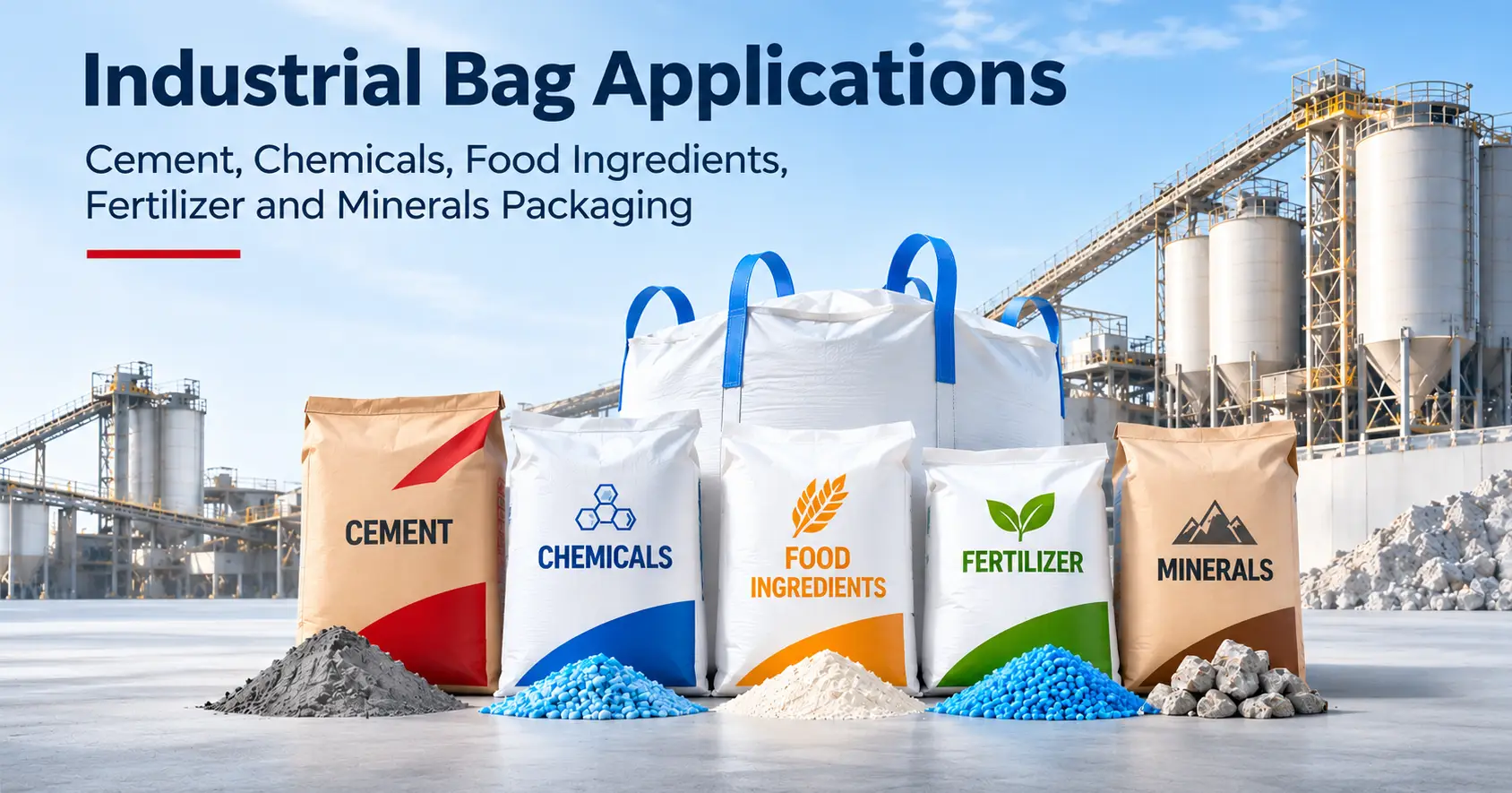
Industrial bag applications for cement, chemicals, food ingredients, fertilizer and minerals packaging

Industrial Bag Applications: Cement, Chemicals, Food Ingredients, Fertilizer and Minerals Packaging

Packing dry materials sounds simple until a sack splits on the conveyor, cement dust coats the filling line, or fertilizer arrives caked and damp. The right bag is rarely the one with the biggest load rating. It is the one that fits your product, your filling equipment, your route and your customer’s emptying process.
This guide explains industrial bag applications across five sectors: cement, chemicals, food ingredients, fertilizer and minerals. You will learn how to compare paper sacks, PP woven bags and bulk bags, what each sector must get right first, and how to brief industrial bulk bag suppliers so the quotes you receive can be compared fairly.
Grid of glasses filled with blue plastic polypropylene granules, masterbatch polymer grain, with shallow DOF. HDPE or PVC resin pellets. 3d render illustration

Plastic Resin Sourcing Guide: What Industrial Buyers Should Check Before Choosing a Supplier

Plastic resin sourcing is not just a search for a matching material code. Industrial buyers need to decide if a supplier can meet the required quality, provide the right documents, deliver on time, agree on terms, and ensure a steady supply without risking production. If you already know the resin family, grade, or specification you need, the next step is to qualify the supplier behind the offer.

I’m Here To Assist You

Contact us today

Please read Terms and Conditions, Privacy Notice, Cookies Notice, and I
I acknowledge that I can withdraw the given consent at any time, and I have understood the terms and conditions and how my personal data is processed.