Key takeaways
Table of Contents
Choosing between paper supply companies can have a direct impact on production efficiency, packaging quality, and supply chain reliability. Whether you’re sourcing kraft paper, linerboard, industrial bags, or specialty grades, selecting the right paper packaging manufacturer requires more than comparing prices. Procurement and production teams need a repeatable way to judge how a paper packaging manufacturer works, how it proves quality and what its paper will cost once it reaches the plant.
Three Types of Paper Supply Companies
Suppliers in this market follow three business models. Each one gives the buyer a different level of control over quality, range and delivery. This sourcing-partner model is used by organizations such as SCG International, which coordinates quality, documentation, and logistics across multiple paper and packaging suppliers.
- Mills: Mills produce base materials such as pulp, kraft paper and linerboard on their own machines. Buyers get a direct quality trail back to production, while the range stays limited to the grades that mill makes.
- Converters: Converters turn base paper into finished items such as industrial bags, cartons and paper cores. They suit buyers who need packaging ready for use on arrival.
- Sourcing partners: Sourcing partners work with several mills and converters and manage quality checks, documentation and freight under one contract. They suit buyers who purchase several grades or ship to more than one market.
Many procurement teams combine these models. A direct mill relationship can cover one high-volume grade, while a sourcing partner covers the wider mix of grades and destinations.
What Should I Check Before Choosing an Industrial Paper Supplier?
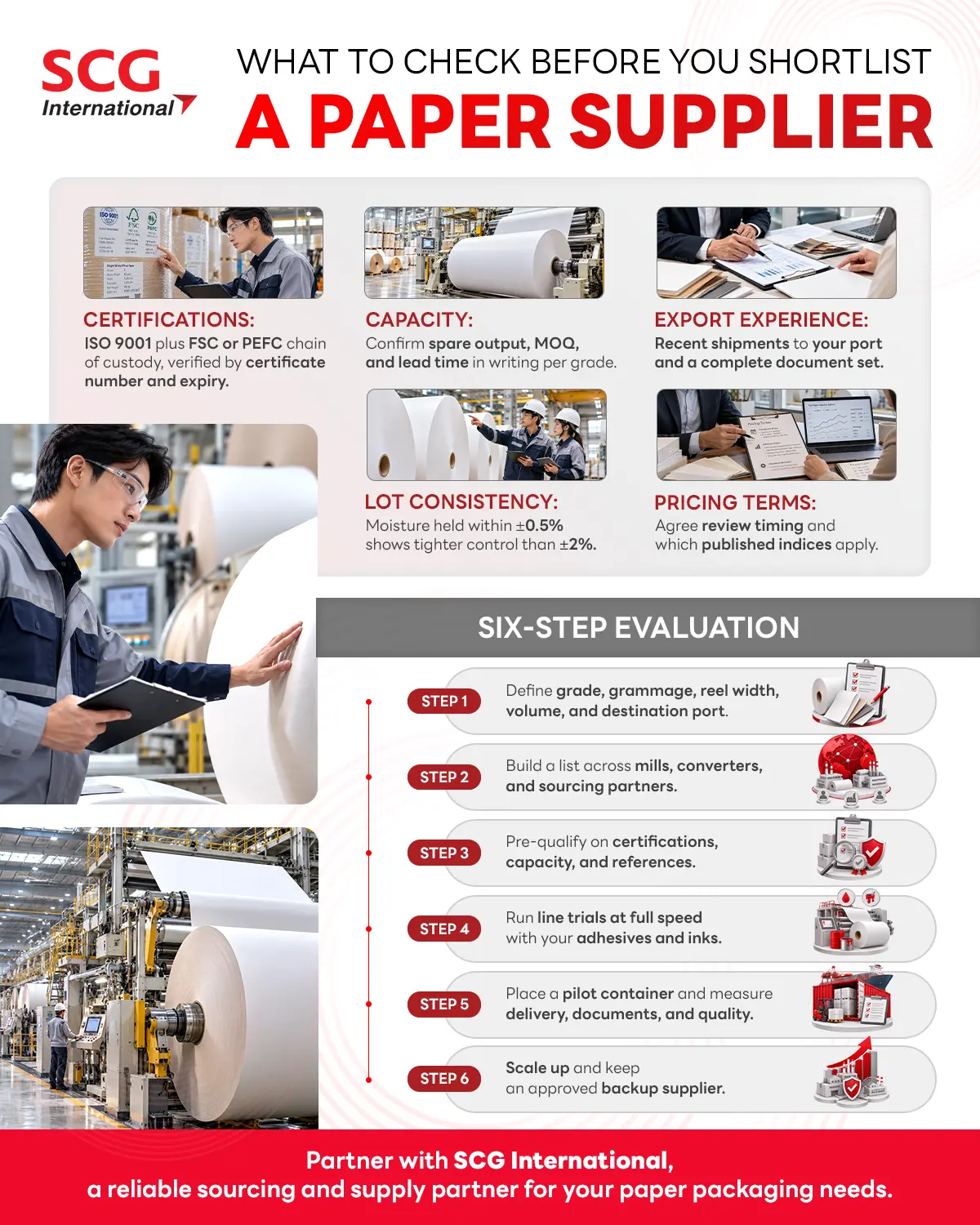
Five checks help a buyer move from a long list of names to a shortlist that can be defended in front of quality, operations and finance teams. Before choosing a paper supplier, verify certifications, review quality documentation, assess export experience, examine lot-to-lot consistency, confirm production capacity, and evaluate total landed cost rather than quoted price alone.
1. What Certifications Should a Paper Supplier Have?
ISO 9001 quality management is the baseline. The revised ISO 9001:2026 was scheduled for publication on September 16, 2026, and certificates issued under ISO 9001:2015 remain valid throughout the transition period. For fiber sourcing, FSC or PEFC chain of custody certification links the paper to responsibly managed forests. FSC is revising its chain of custody standards, and buyers can ask suppliers which version their certificate covers.
– Certificate verification: Request certificate PDFs that show the certificate number, issuing body and expiry date, then check FSC numbers against the official FSC database. Confirm whether the producing mill or a trading affiliate holds the certificate, because that distinction affects your own compliance records.
– Per-shipment certificate of analysis: Each shipment should carry a certificate of analysis listing grammage, moisture and burst strength along with the test method used. Burst results measured under ISO 2758 and TAPPI T 403 can differ for identical paper, and named methods keep quotes comparable.
– EU market readiness: Buyers shipping fiber-based packaging into the EU should ask suppliers about the EU Deforestation Regulation. It applies to large operators and traders from December 30, 2026, with micro and small enterprises following on June 30, 2027, and fiber-based packaging products remain in scope.
2. Capacity Headroom for Peak Volume
A supplier running close to full output has little room to absorb a rise in your orders. Ask what share of production your volume represents and how the supplier plans for peak season. Confirm minimum order quantities and lead times in writing for each grade you intend to buy.
3. Export Experience at Your Destination Port
A missing or incorrect document can hold a container at port even when the paper meets specification. Ask for examples of recent shipments to your destination and confirm which documents the supplier prepares as standard. A typical set includes a commercial invoice, packing list, bill of lading, certificate of origin where required, and product test records.
4. Grade Consistency Across Multiple Lots
One good sample shows what a mill can produce on a good day. A supplier that delivers a perfect sample reel but struggles to maintain performance over multiple production lots can create costly downtime once volumes increase. Mills that hold moisture within a narrow band such as ±0.5% demonstrate tighter process control than those quoting ±2%, and that control shows up as fewer curl and adhesion problems on converting lines.
5. Transparent Pricing and Review Mechanisms
Paper prices follow pulp, energy and freight costs. Agree in advance when prices will be reviewed and which published indices the review will reference. Clear rules keep buyer and supplier working from the same numbers when input costs move.
How Do I Choose a Paper Packaging Manufacturer?
A six-step evaluation turns a long list of candidates into a supply base you can rely on for years.
- Define specifications: Record grade, grammage, reel width, annual volume and destination port before contacting suppliers. Precise specifications make every quote comparable from the first round.
- Build a candidate list: Include mills, converters and sourcing partners, giving the shortlist a view of every supply model available for your grade.
- Pre-qualify candidates: Filter on verified certifications, spare capacity and references from buyers in similar industries.
- Run line trials: Test sample reels on your own machines at full production speed with your usual adhesives and inks. Lab data confirms the specification, and the trial shows how the paper behaves in your plant.
- Place a pilot order: Ship one container and measure delivery timing, document accuracy and quality on arrival against the agreed specification.
- Scale up with a backup: Award volume to the strongest paper packaging manufacturer and keep an approved second supplier active for continuity.
How to Calculate the Total Landed Cost of Paper
The lowest quote per tonne may still produce a higher cost per finished pack. Total landed cost adds every charge between the mill and your production line.
– Incoterms: Compare quotes on the same delivery basis. Under Incoterms 2020, an EXW price leaves export clearance, loading and main freight to the buyer, while a CIF price includes sea freight and minimum insurance to the destination port.
– Freight and surcharges: Ocean freight can change quickly. In 2026, Fastmarkets estimated that each US$100 surcharge on a 40-foot container adds roughly USD 4 to USD 5 per tonne to the cost of recovered paper shipped to Asian mills.
– Payment terms: Longer payment terms release working capital, and that benefit carries a real value when two offers sit close on price.
– Line waste and rejections: Paper that breaks, curls or jams creates downtime and scrap. A lower base price loses its advantage quickly once rejected rates climb.
Energy adds another variable. Mills in China, India and most of Southeast Asia rely on coal for 71% to 76% of purchased energy in paper and board production, which leaves them less exposed to oil and gas prices than mills in Japan, South Korea and Malaysia. Ask each supplier how its pricing responds when energy costs change.
How SCG International Supports Paper Packaging Buyers
SCG was founded in Thailand in 1913, entered the packaging business in 1976 and has operated an international trading business since 1978, according to SCG’s company history. Its packaging business, SCGP, produces packaging paper in rolls and sheets, corrugated board and paper cores.
Within the group, SCG International sources industrial paper and packaging from SCG group production and verified mills in Thailand, then runs the commercial and quality coordination for buyers across Asia, the Middle East, Oceania and Africa. Its range covers kraft paper, specialty kraft paper, industrial bags, plasterboard liner, printing and writing paper, core board, duplex paper, sack kraft paper, recycled paper and pulp.
These capabilities line up with the checks in this guide. Batches are quality-checked and laboratory-tested before dispatch, and the test records travel with each shipment. SCG International coordinates export documentation to suit the destination market and the agreed Incoterms, can consolidate more than one grade into a single shipment where the order allows, and confirms MOQ and lead time with each quotation. If a consignment misses the agreed specification on arrival, the local SCG team manages the claim with the mill directly. For buyers weighing up paper supply companies, this gives one commercial contact backed by SCG’s production credibility, with each paper packaging manufacturer in the network verified before supply.
Build a Steadier Paper Supply Chain with SCG International
Reliable packaging supply depends on more than price. It requires proven quality, dependable logistics, verified certifications, and a partner that can manage complexity across markets. SCG International helps buyers secure consistent paper and packaging supply through trusted mills, converters, and verified producers. Contact the team to discuss your requirements and build a more resilient paper supply chain. Contact SCG International to start the conversation about your paper and packaging supply.
References :
– ISO 9001 Revision Update: Publication Date Confirmed. Retrieved October 20, 2026, from https://www.lrqa.com/en-us/latest-news/iso-9001-revision-update-publication-date-confirmed
– Consultation Open: Revision of FSC’s Chain of Custody Standards. Retrieved October 20, 2026, from https://fsc.org/en/newscentre/general-news/consultation-open-revision-of-fscs-chain-of-custody-standards
– EUDR Application Postponed Again by One Year. Retrieved October 20, 2026, from https://www.euwid-paper.com/news/markets/eudr-application-postponed-again-by-one-year/
– Cumulative Effects of Energy Shock Will Not Go Unnoticed in Asia. Retrieved October 20, 2026, from https://www.fastmarkets.com/insights/cumulative-effects-of-energy-shock-will-not-go-unnoticed-in-asia/
– Kraft Paper Manufacturers Capability Matrix: Compare GSM, BF/BST, Moisture Control, and Certifications Without Guesswork. Retrieved October 20, 2026, from https://www.paperindex.com/academy/kraft-paper-manufacturers-capability-matrix-compare-gsm-bf-bst-moisture-control-and-certifications-without-guesswork/
– Our History (SCG). Retrieved October 20, 2026, from https://www.scg.com/en/about-scg/milestones
– Retrieved October 20, 2026, from https://www.scg.com/scg-business/overview/scgp
Industrial Paper & Packaging Supplier (SCG International). Retrieved October 20, 2026, from https://scginternational.com/products/paper-packaging/